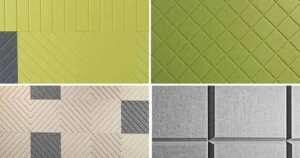
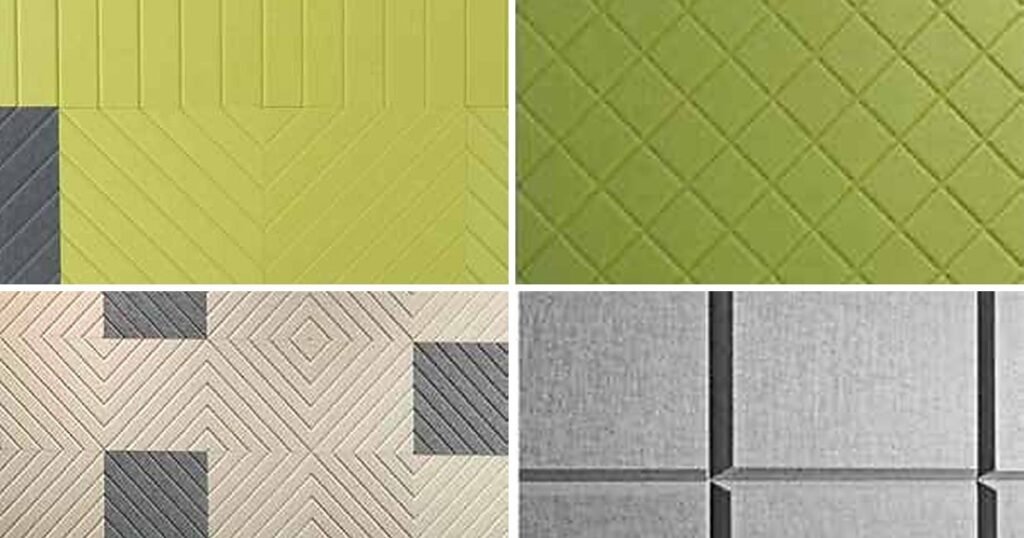
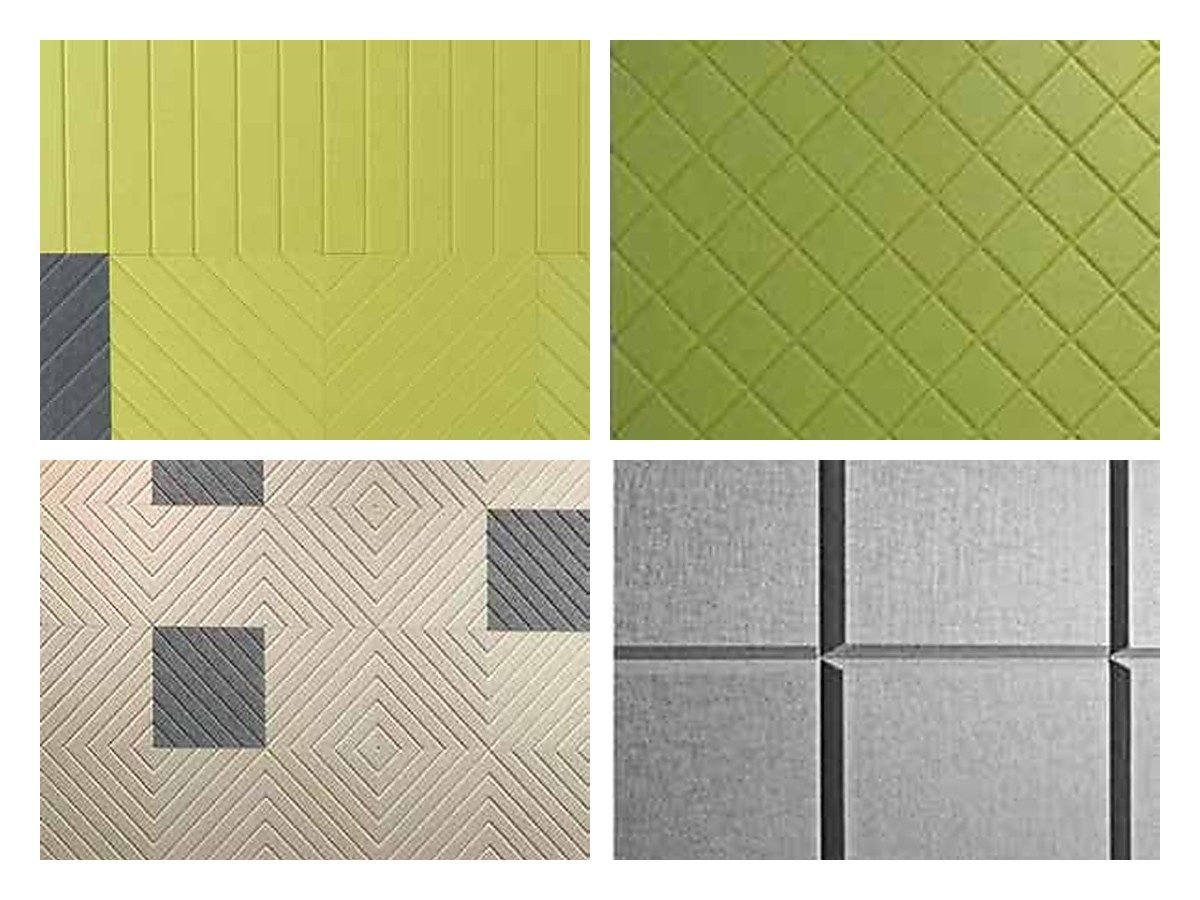
A drawing calls for a feature wall in “V-groove PET felt”. Three suppliers return three samples: shallow, wide channels that read as soft shading; deep, tight cuts that look like separate tiles; grooves that stop short of a corner and restart on the return. All are genuine V groove PET felt wall panel design work, yet only one will look continuous once installed. The difference is not taste but groove angle, cut depth, panel thickness and how the pattern resolves at edges. Those choices are made on paper months before installation and are costly to change afterwards.
This guide is for those who sign off the schedule — architects, acoustic consultants, main contractors, distributors and procurement managers. It explains what the cut does to the felt, which thicknesses leave enough residual wall, how patterns resolve at corners and openings, how colours behave, and what to put in an RFQ so competing quotations describe the same panel. It is supplier-side and technical, not consumer decorating advice. All numbers are indicative planning guidance; final geometry, tolerances and terms must come from the supplier’s drawings and the formal quotation.
What the V groove in a PET felt panel actually is
A V groove is a channel routed into the face of a polyester-fibre (PET) felt panel with a V-shaped cutter. The cutter removes a triangular section, leaving two sloping flanks that meet at a valley. Under raking light the flanks shade differently, so the pattern reads as crisp lines without a print or second material. Because it is a mechanical cut into the panel body, its geometry has to be engineered, not merely drawn.
This matters for a V groove PET felt wall panel design because the cut removes material and leaves a thinner residual wall beneath the valley. Cut too shallow and the line barely registers; too deep and the panel loses stiffness, the valley can tear in handling, and the face becomes vulnerable at corners and fixings. The design task is balancing line strength against the felt left to carry it.
Four parameters describe almost every grooved panel; fix these and a supplier has something checkable to price:
- Included angle — the angle between the two flanks. A narrower angle gives a finer, sharper line; a wider angle a softer, broader shadow.
- Cut depth — how far the valley sits below the face, measured from the uncut surface.
- Pitch — the centre-to-centre spacing of the grooves, setting the visual rhythm and the number of cuts per square metre.
- Residual wall — the felt remaining beneath the valley. This governs stiffness and durability, and is the number most often omitted from a schedule.
See the V-groove PET felt wall panel listing and the V-groove wall category to see these on real products, then require the same in writing from every supplier.
Groove geometry: angle, depth and pitch
Angle and depth work together. As indicative guidance a 90-degree cutter is the general-purpose choice: a legible line without an aggressive valley. A narrower 60-degree tool reads finer and is more sensitive to felt density; a wider 120-degree tool gives a broad, gentle shadow for large walls viewed at distance. Factories grind their own tools, so the angle must be stated on the drawing.
| Groove form (indicative) | Included angle | Visual read at 3 m | Residual-wall sensitivity | Typical use |
|---|---|---|---|---|
| Fine V | ~60° | Fine, sharp line | High — thinner valley | Close-view feature walls |
| Standard V | ~90° | Balanced, legible rhythm | Moderate | General walls and panels |
| Broad V | ~120° | Soft shadow, broad line | Lower | Large areas at distance |
| Mixed pitch | Per drawing | Alternating bands | Varies by cut | Graphic feature walls |
Pitch is a planning number too: a 30 mm pitch roughly doubles the cuts of a 60 mm pitch over the same area, affecting machining time, edge break and price — and a pitch that does not divide into the module drifts out of alignment. See the guide to PET felt panel thicknesses (9/12/24 mm).
Minimum thickness and the residual wall
This is the constraint that decides whether a design is buildable. The same cut into a 9 mm sheet and a 24 mm sheet leaves very different sections. As indicative guidance, keep a meaningful residual wall — a useful starting point is at least half the nominal panel thickness for a wall panel, and more where it is handled often, fixed at close centres or used overhead. The safe minimum depends on density, groove angle and panel size, and must be confirmed by the fabricator for the specific panel.
Density matters as much as thickness. Higher-density felt holds a cleaner groove edge and tolerates a deeper cut than a soft sheet, which can crumble at the valley and show a fuzzy edge after handling. If the design calls for a fine V, ask which density the sample was cut from and whether the production batch will match. The density and thickness performance matrix frames the discussion; require data for your exact panel.
A groove is a local reduction in section, so a heavily grooved panel behaves differently from a flat sheet when it is lifted, fixed or knocked at a corner. Ask for the recommended handling method and fix centres for the grooved face, not the ungrooved board.
Pattern families and how they are laid out
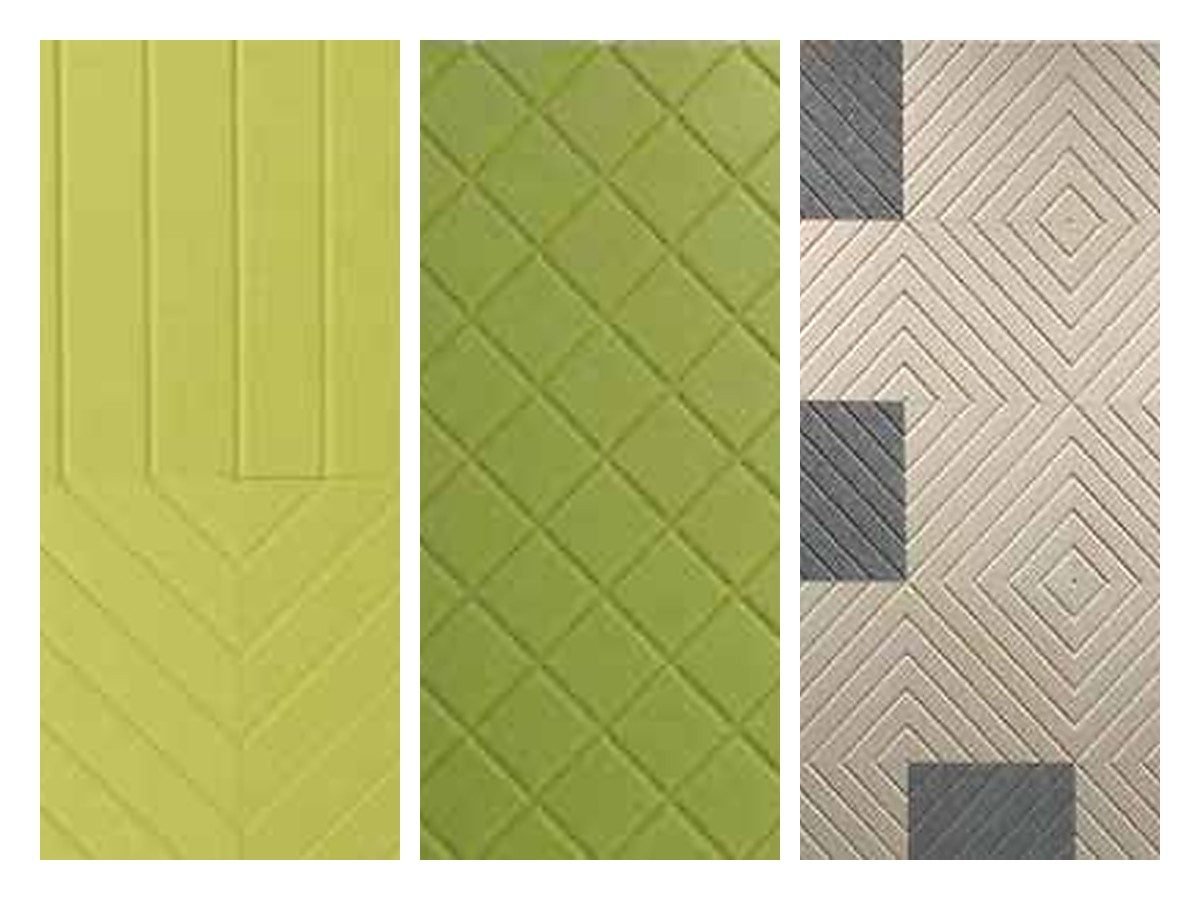
Most designs fall into a few families, each resolving differently at a joint. Vertical parallel lines are the most forgiving and can continue across panels if the pitch divides into the module. Horizontal lines read strongly but need careful levelling. Diagonal or chevron patterns need a setting-out drawing to keep the apex aligned. Mixed-pitch bands are the most graphic and the most sensitive to batch consistency.
Three rules keep a pattern tidy. Set the module from the pitch, not the other way round. Mark groove direction on every drawing and carton — a panel rotated ninety degrees on site breaks the run. Agree what happens at a joint: a shadow gap, a butt joint with continuous lines, or a deliberate break. The guide to panel edge profiles and shadow gaps shows how edge treatments change the finished read.
On curved panels the cut opens on the outside of a bend and closes on the inside, so radii and thickness must be checked together; the notes on curved and three-dimensional acoustic panels give general limits, but require a sample of the actual grooved curve before approval.
V groove PET felt wall panel design at corners, edges and openings
Corners are where a V groove PET felt wall panel design is most often judged. On an internal corner the pattern can continue around the return if both faces share the pitch and a common datum. On an external corner the groove must terminate in a clean mitre or stop short of a protective trim; a channel running off a sharp arris gives a weak, easily chipped edge. State the condition explicitly — “continue and mitre” is far clearer than leaving it to the installer.
Openings need the same care. At a door reveal, recessed light slot or service penetration, decide whether the pattern stops at the reveal or wraps into it, and how the cut face is finished. Terminate groove ends consistently rather than letting them die out at random. Where the wall meets a ceiling or suspended system, set out with other trades so a groove does not land on a movement joint.
Fixing is part of the detail. Adhesive, clips or a keel system all interact with a grooved face, and fix centres should avoid the weakest point of the cut. The overview of adhesives, Z-clips and mounting hardware and the grooved-panel mounting clip and keel set are useful starting points for the fixing schedule.
Colour combinations and batch control
Because the groove reveals the flanks of the cut, colour changes how strongly the pattern reads. A single-colour panel gives a quiet, tonal line and suits large fields where texture should not dominate. A darker core behind a lighter face adds contrast at the groove, but the effect depends on cut depth, so it must be sampled rather than assumed. Mixed-colour panels are specified by agreeing which colour fills the groove field and which forms the border.
Batch consistency is the practical risk: felt is dyed in runs, and a panel replaced later can differ in tone even with identical geometry. Hold one signed golden sample, agree a written tolerance and order spares from the same run. The custom-colour acoustic felt panel listing explains colour specification; where a printed graphic is also needed, the printed acoustic felt wall panel page shows how print and grooving combine. For lit spaces, add the note on colourfastness and UV stability to the submittal.
Application scenarios for a V groove PET felt wall panel design
The same panel serves very different rooms; the specification shifts with viewing distance and the level of handling.
- Reception and lobby feature walls: strong raking light makes a standard or broad V read well at distance; specify a robust residual wall because the surface is touched and cleaned often.
- Meeting rooms and boardrooms: a fine, regular pattern adds texture without visual noise behind a camera; keep the groove direction consistent with the table axis.
- Open-plan offices: large grooved fields break up plain walls; coordinate pitch with panel module so long runs stay aligned, and check the acoustic build-up separately.
- Retail and showrooms: graphic mixed-pitch patterns create identity; order spares from the same batch because replacement panels are highly visible.
- Corridors and circulation: durability drives the choice — a wider groove with a generous residual wall survives knocks better than a fine, deep cut.
A groove is a visual device, not a substitute for an acoustic specification. Absorption comes from the porous felt body and any cavity or backing, so keep the acoustic build-up in the same line of the schedule. The room treatment solutions overview shows how wall and ceiling areas are coordinated; the note on wholesale PET felt panels discusses acoustic data, but figures must be for the exact grooved assembly.
Selection and RFQ checklist
A request saying only “V-groove PET felt wall, 400 m2” cannot be compared fairly: suppliers assume different depths, densities and edge conditions, and the lowest price usually reflects the least material left in the panel. Send the same data to every bidder and ask for the response in the same structure. The catalogue and resources page is a useful source of standard modules and colour cards.
- Groove definition: included angle, cut depth, pitch, direction and residual wall, shown on a dimensioned section.
- Panel specification: stock thickness, felt density, panel module, finished size and tolerances.
- Pattern and set-out: joint type, how the pattern continues across panels, corner and opening conditions, and a setting-out drawing.
- Colour and batching: colour reference, golden sample, written tolerance and spare-panel ratio from the same run.
- Fixing: adhesive, clips or keel, fix centres and the handling method for the grooved face.
- Acoustic and fire data: absorption figures by band for the exact assembly, plus a reaction-to-fire classification for the complete panel — facing, core and any backing or adhesive.
- Commercial terms: unit basis, MOQ, incoterm, lead time, packing and the number of spares.
For a normalisation worksheet see comparing acoustic panel quotations; when the schedule is complete, the contact page sends it straight to the technical team.

Common mistakes in V groove PET felt wall panel design
- Specifying depth but not residual wall. Depth alone says nothing about how much felt remains. Require both on the section drawing.
- Assuming the groove improves absorption. It is primarily a visual cut. Ask for coefficients on the grooved assembly if absorption is part of the brief.
- Letting pitch and module disagree. A pitch that does not divide into the panel width drifts out of alignment and breaks at every joint.
- Leaving corners to site judgement. Mitre, stop or wrap — state the corner condition, or it will be resolved inconsistently on site.
- Ignoring density. The same cut looks crisp in dense felt and fuzzy in soft felt. Approve a sample cut from production-grade material.
- Replacing panels from a new batch. Tone shifts are common; hold spares from the original run and a signed golden sample.
Each is cheap to resolve at submittal and costly after the wall is fixed. Build them into the drawing review, not the snagging list.
Request a quote and download the catalogue
A V groove PET felt wall panel design is defined by its cut geometry, its residual wall and the way its pattern resolves at corners and openings — not by the words “V-groove felt” on a schedule. Fix the angle, depth and pitch, hold enough felt beneath the groove, set the module from the pitch, and require acoustic and fire documents for the exact panel supplied. To review standard modules, thicknesses and colour cards in one place, download the catalogue. When your specification is ready, request a quote and send the checklist above — our technical team will return a like-for-like proposal with the section drawing and reports to match.
Frequently asked questions
What is a V groove PET felt wall panel design?
It is a specification for PET felt panels whose face is routed with V-shaped channels. The design is defined by groove angle, cut depth, pitch and the residual wall beneath the cut, plus how the pattern resolves at joints, corners and openings. Treat it as a dimensioned geometry, not a product name.
How deep can the groove be cut?
As indicative guidance, keep at least half the nominal panel thickness beneath the valley for a wall panel, and more where it is handled often or fixed overhead. The safe depth depends on felt density, groove angle and panel size, so confirm the exact minimum with the fabricator and approve a sample cut from production-grade felt.
Does V grooving improve sound absorption?
The groove is primarily a visual cut. Absorption comes from the porous PET felt body and from any cavity or backing behind the panel. If absorption is part of the brief, request coefficients by frequency band for the exact grooved assembly rather than assuming the pattern helps.
Can the grooves continue across panel joints and corners?
Yes, if the pitch divides evenly into the panel module and both faces share the same datum. State the corner condition explicitly — continue and mitre, stop short of a trim, or wrap into the reveal — otherwise it will be resolved inconsistently on site.
Which felt thickness and density should I specify?
Common stock thicknesses are around 9, 12 and 24 mm, but the right choice follows from the groove depth and residual wall you need. Higher-density felt holds a crisper edge and tolerates a deeper cut. Confirm both thickness and density for the exact panel with the supplier.
What should I send in an RFQ for grooved panels?
Send the groove section (angle, depth, pitch, residual wall), stock thickness and density, panel module, setting-out and corner details, colour reference and golden sample, fixing method, and the acoustic and fire documents required for the complete assembly. Ask every bidder to respond in the same structure.