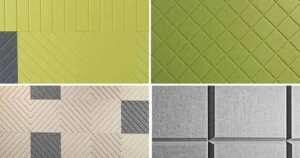
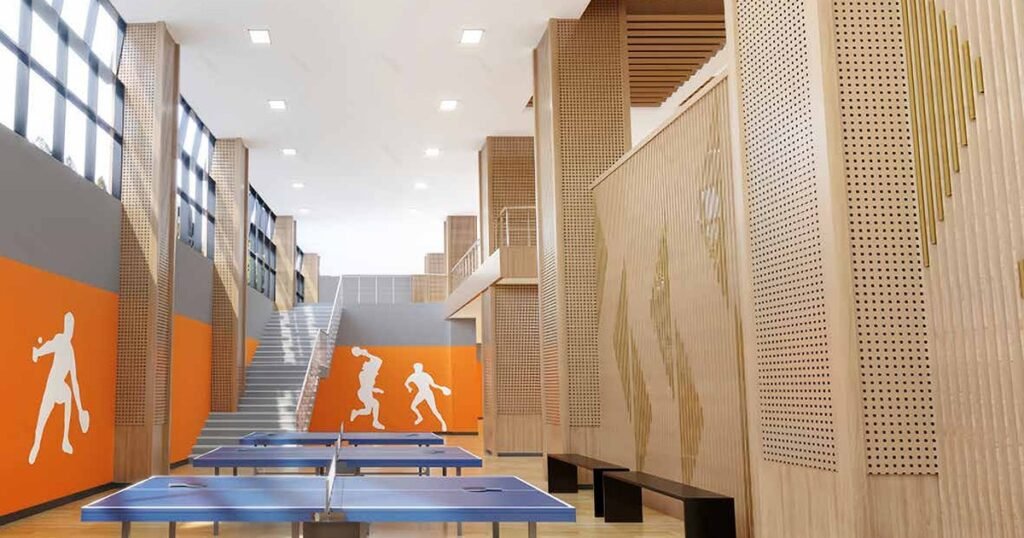
A schedule calls for a “perforated wood acoustic panel 28/4”. Three suppliers quote it, and three different panels arrive in the samples box: narrow slots every 28 mm, round holes, and a deeper groove with a different open area. The drawings all look convincing, and none states what sits behind the facing. Six weeks later the room fails its reverberation target and nobody can agree whether the pattern, the backing or the fixing was at fault. This is the cost of treating a perforated wood acoustic panel 28/4 as a product name rather than a specification.
This guide is for those who sign off the schedule — architects, acoustic consultants, main contractors, distributors and procurement managers. It decodes the 28/4 marking, turns it into an open-area figure, compares neighbouring patterns, explains the role of backing and cavity, and ends with an RFQ checklist. It is supplier-side and technical, not consumer decorating advice. All figures are indicative planning guidance; final geometry, performance and terms must come from project data, the supplier’s drawings and the formal quotation.
What the 28/4 notation actually means
A marking such as 28/4 is a manufacturer’s shorthand for the geometry of the face. In the convention used across much of the timber acoustic panel industry, the first number is the centre-to-centre pitch of the openings in millimetres, and the second is the nominal opening — slot width or hole diameter — in millimetres. Read that way, 28/4 describes an opening every 28 mm with a 4 mm aperture. A 14/2 pattern has finer, closer openings; a 40/3 has a wider pitch. Prefixes add a layer: “E” commonly means a round perforation, “V” a V-groove rather than a straight cut.
For a buyer, the key point is that this is a convention, not a universal standard. Two factories can use the same four characters for different profiles. Buyers searching for a perforated wood acoustic panel 28/4 often land on both perforated and grooved listings, because the same pitch-and-aperture logic applies across both families. Acoustically the question is identical: how much of the face is open, what is behind it, and how deep is the cavity.
Treating the marking as four numbers to be verified, rather than as a model name, gives you a specification you can compare and a panel you can inspect on delivery. Four parameters do the work:
- Pitch — the centre-to-centre distance between openings. It sets the visual rhythm and, together with aperture, the open area.
- Aperture — the slot width or hole diameter. It influences both appearance and how freely air moves through the facing.
- Open area percentage — the fraction of the face that is actually open. This is the number that drives the acoustic behaviour.
- Build-up behind the face — the core, the acoustic backing and the cavity depth. Without this, no open-area figure predicts performance.
MST Acoustics documents these parameters on the product pages for the 28/4 grooved wood acoustic panel and across the wider perforated wood acoustic panel range. Use those pages as a starting point, then require the same information in writing from any supplier you shortlist.
From notation to open area percentage
Open area is the most useful number you can extract from a pattern marking, because it converts a visual description into a checkable quantity. For a straight slot pattern, the indicative calculation is slot width divided by pitch: a 28 mm pitch with a 4 mm slot gives roughly 4 / 28 = 14% open area. For a round perforation on a square grid, divide the hole area by the cell area — pi times the radius squared over the pitch squared. A 6 mm hole on a 32 mm grid works out at only a few percent. These are geometric estimates, not performance ratings; the real value must be confirmed against the supplier’s drawing.
| Marking (indicative) | Typical face form | Pitch | Aperture | Indicative open area | Typical use |
|---|---|---|---|---|---|
| 14/2 | Fine linear slot | 14 mm | 2 mm | ~14% | Fine texture, close viewing distance |
| 28/4 | Medium linear slot | 28 mm | 4 mm | ~14% | General walls and ceilings, balanced |
| 40/3 | Wide pitch, narrow slot | 40 mm | 3 mm | ~7.5% | Strong graphic rhythm, lower openness |
| 59/5 | Wide pitch, wide slot | 59 mm | 5 mm | ~8.5% | Large-format feature walls |
| E32/6 | Round perforation, square grid | 32 mm | 6 mm dia. | ~2.8% (confirm on drawing) | Micro-perforated appearance |
| V32/8 | V-groove (directional) | 32 mm | 8 mm | Per supplier drawing | Linear feature panelling |
Treat this table as a way to frame the conversation, never as a schedule. Hole form, grid and backing all change the result, and a supplier may define “aperture” at the face or at the narrowest point of the cut. Ask for the open-area calculation with the drawing, for the exact panel supplied — see the E32/6 perforated panel for how a round-hole pattern is presented.
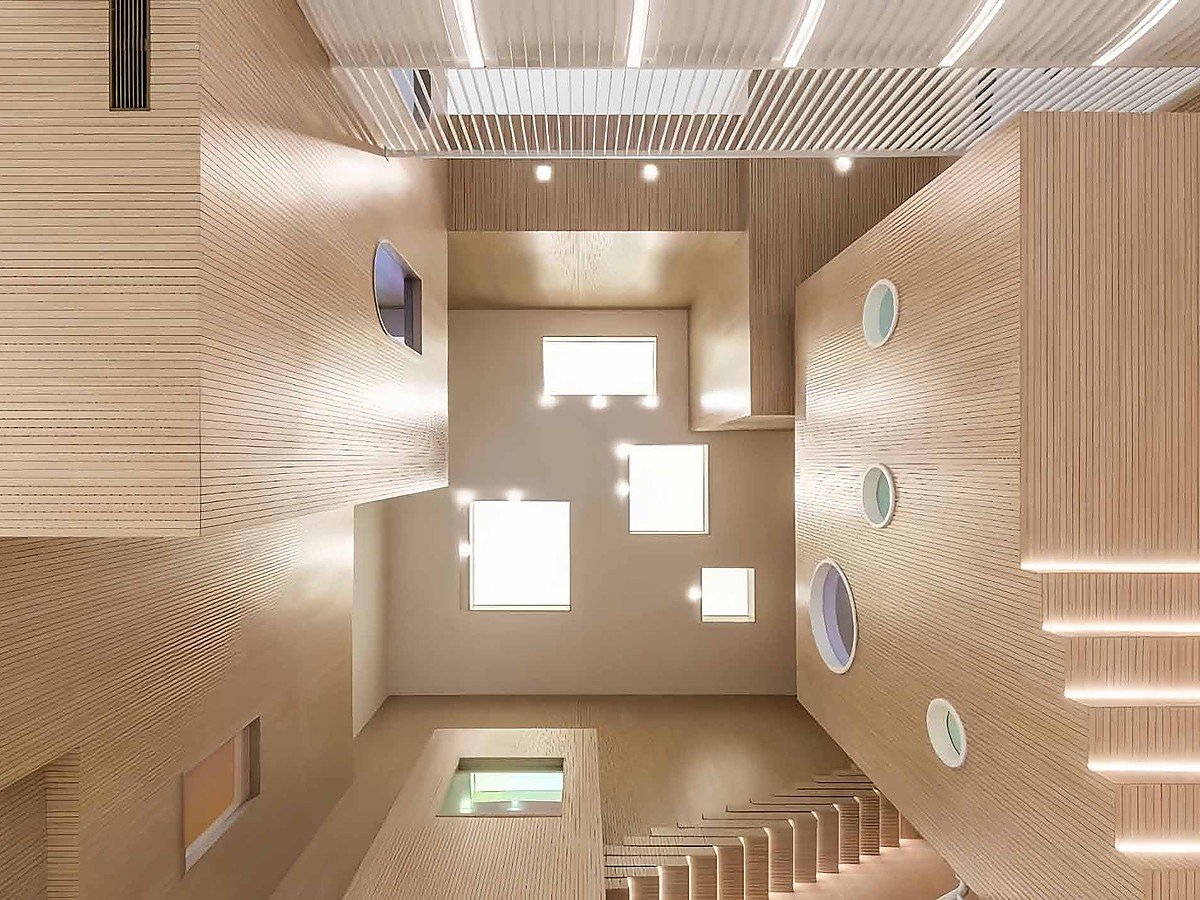
Perforated wood acoustic panel 28/4 compared with other patterns
Once the open-area figures are on the table, pattern selection becomes a design and acoustic trade-off rather than a matter of taste. The comparison below is indicative only; it is meant to help you ask the right questions of a consultant or supplier, not to replace a room model or a test report on the exact assembly.
| Criterion | 28/4 medium slot | Fine 14/2 slot | Wide 59/5 slot | E32/6 round |
|---|---|---|---|---|
| Indicative open area | ~14% | ~14% | ~8.5% | ~2.8% |
| Visual read at 3 m | Balanced linear rhythm | Fine, almost textural | Bold, architectural | Subtle, dotted |
| Openness to backing | Moderate | Moderate | Lower | Low unless backed appropriately |
| Typical acoustic role | General absorption with felt/wool backing | Absorption with a refined face | Absorption plus strong visual identity | Fine-texture absorption, detail-sensitive |
| Detailing watch-point | Align slots across panel joints | Avoid visible pitch drift over large runs | Control joint shadow gaps | Confirm hole grid at panel edges |
Two 14%-open patterns can still behave differently: slot orientation, facing thickness and backing all matter. For the underlying concepts, see the earlier article on perforated wood hole patterns; the V32/8 and E4/4 micro-perforated listings show how the notation varies.
How backing and cavity change the absorption curve
A perforated facing does not absorb much on its own. It works as part of a system: the openings behave like an array of small acoustic masses, the air in the cavity behind them behaves like a spring, and a porous backing — mineral wool, glass fibre or PET felt — supplies the resistance that turns motion into heat. This is the mechanism behind a perforated-panel absorber, and it is why changing the backing or the cavity can matter more than changing the pattern by a few millimetres.
The practical relationships are worth stating plainly. A deeper cavity generally lowers the frequency of strongest absorption, so a surface-mounted panel and the same panel on a 200 mm batten cavity will not perform alike. More open area raises the resonant frequency and broadens the useful band, up to a point; too little and air cannot reach the backing, too much and the facing loses its acoustic mass. As indicative guidance, effective open area for a timber-faced absorber often sits in the 5–30% band, many architectural patterns between 10% and 20%. The optimum depends on cavity depth, backing density and the frequencies to be treated, and must come from test data on the exact build-up.
This interaction is covered in more depth in our guide to acoustic panel air gap absorption, and how to read the figures in the NRC test report verification guide. The lesson for a 28/4 specification is simple: never approve the pattern before the backing and cavity are in the same line of the schedule. A felt-backed, surface-fixed panel and a mineral-wool-backed panel on a deep cavity are different products even with an identical face.
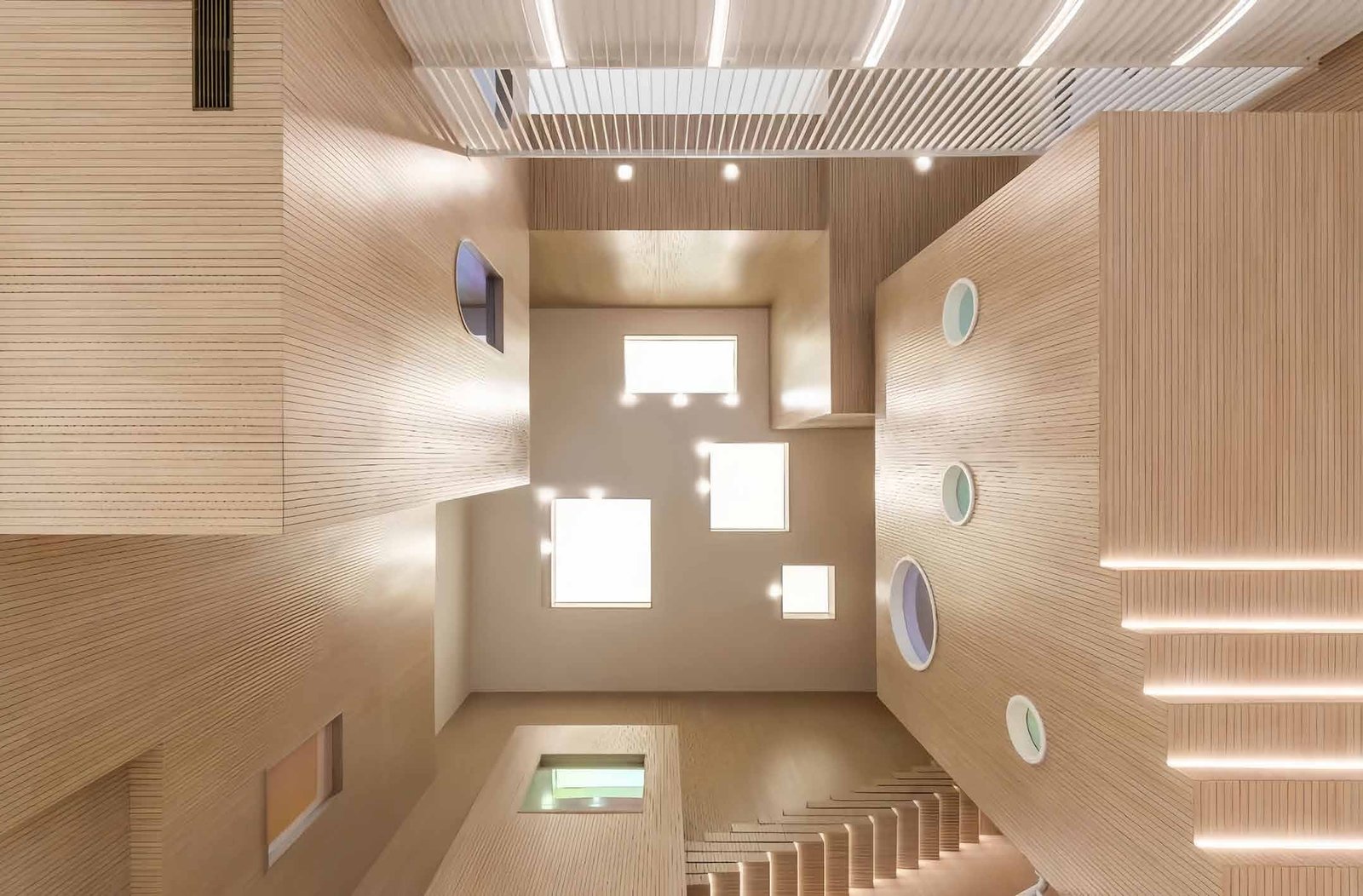
Application scenarios for a perforated wood acoustic panel 28/4
The 28/4 medium slot suits spaces where a warm timber appearance must coexist with real absorption at ordinary viewing distance. Each scenario below uses the same marking differently; in all of them the backing, cavity and fixing are part of the decision, not afterthoughts.
- Boardrooms: speech clarity drives the specification. A felt- or wool-backed 28/4 panel on walls and ceiling reduces reverberation while keeping a premium finish; align slots with the table axis.
- Auditoria: timber facing is chosen for warmth, but absorption figures must come from the tested assembly. Combine perforated fields with diffusion on distant rear walls, as in our absorption vs diffusion guide.
- Hotel lobbies: the finish must look architectural and survive handling. Specify durability, confirm the fire classification of the whole assembly, and keep spare panels from the same batch.
- Libraries: consistent slot alignment across long runs matters visually; a medium pattern with a robust backing is easier to keep tidy than a very fine slot.
- Open-plan offices: absorption is needed at ceiling level and on large bare walls. Check that open area and cavity deliver the low-to-mid frequency control the model assumes.
Where the project also needs room zoning or a wider product schedule, the room treatment solutions overview shows how wall and ceiling areas are coordinated. Every one of the cases above should end with the same deliverable: a setting-out drawing that shows slot alignment, joint positions and the backing build-up together.
Selection and RFQ checklist for a perforated wood acoustic panel 28/4
A request for quotation that says only “28/4 perforated wood panel, 500 m2” cannot be compared fairly. Suppliers will fill the gaps differently and the lowest price will usually be the one that assumed the least. Send the following information with every enquiry, and ask for the response in the same structure so you can compare like for like. The catalogue on our resources page is a useful source of standard dimensions and finishes to reference in your schedule.
- Pattern definition: pitch, aperture, hole or slot form, facing thickness, and the open-area figure with its calculation.
- Panel module: standard size, finished thickness, joint type, and how the pattern aligns across adjacent panels.
- Build-up: veneer species and cut, core material, backing material and density, and adhesive system.
- Mounting: surface-fixed or batten cavity, cavity depth, fixing clips or adhesive, and the tested mounting condition for the acoustic data.
- Acoustic data: absorption coefficients by frequency band and the single-number rating, with laboratory and report reference.
- Fire and emissions: reaction-to-fire classification for the complete assembly, plus VOC or formaldehyde documentation where required.
- Finish and batching: colour range, golden sample reference, tolerance for veneer variation, and batch continuity across the area.
- Commercial terms: unit basis (per panel or per square metre), MOQ, incoterm, lead time, packing and spare-panel ratio.
For a ready-made format, our guide to comparing acoustic panel quotations sets out a normalisation worksheet, and the contact page is where you can send the completed RFQ directly to the technical team.

Common mistakes when specifying perforated patterns
Most disappointing perforated-wood installations fail for reasons that were visible on the drawings. A short list of recurring problems is worth keeping next to the specification during design development and submittal review.
- Treating the marking as a standard. 28/4 is a convention, not a guarantee of geometry. Require a dimensioned drawing and an open-area figure from each supplier.
- Approving the face before the backing. The same facing over felt, mineral wool or an empty cavity performs differently. Approve the assembly, not the veneer sample.
- Quoting a single NRC number. It hides the frequency behaviour that matters in speech rooms and large spaces. Ask for the full band table and the mounting condition.
- Ignoring slot alignment at joints. A 28/4 pitch that does not divide into the panel module produces visible breaks in the rhythm across a long wall.
- Mixing batches without a golden sample. Veneer tone and open-area consistency are both batch-sensitive; hold one signed sample for the whole project.
- Overlooking fire documentation scope. A classification for one component is not a classification for the assembled panel with its backing and adhesive.
Each is cheap to fix on paper and expensive after installation. Build them into the submittal review, not the snagging list.
Request a quote and download the catalogue
A perforated wood acoustic panel 28/4 is defined by its geometry and its build-up, not by the four characters in a product name. Turn the marking into a dimensioned specification, fix the open area, backing and cavity together, and require the acoustic and fire documents for that exact assembly. If you would like the standard dimensions, finishes and technical data in one place, download the catalogue. When you are ready to test a specification against a real quotation, request a quote and send the RFQ checklist above — our technical team will return a like-for-like proposal with the drawings and reports to match.
Frequently asked questions
What does 28/4 mean on a perforated wood acoustic panel?
In the common industry convention, 28/4 describes the face geometry: a 28 mm centre-to-centre pitch between openings and a nominal 4 mm slot width or hole diameter. It is a shorthand, not a universal standard, so always confirm the exact profile, hole form and open area on a dimensioned drawing from the supplier.
What is the indicative open area of a 28/4 pattern?
For a straight slot, slot width divided by pitch gives an indicative 4 / 28, or about 14% open area. This is a geometric estimate only. The real figure depends on the exact cut, facing thickness and grid, and must be confirmed against the supplier’s drawing and the backing specified with it.
Is a perforated wood acoustic panel 28/4 a fire-rated product?
The pattern says nothing about fire performance. Ask for a reaction-to-fire classification, such as an EN 13501-1 Euroclass or an ASTM E84 result, for the complete assembly — facing, core, backing and adhesive — not for a single component. The certificate must match the exact build-up being supplied.
Does a higher open area always mean better sound absorption?
No. Open area, cavity depth and backing work together. Too little prevents air reaching the absorbent backing; too much reduces the facing’s acoustic mass and shifts absorption upward in frequency. As indicative guidance, many timber-faced absorbers fall between 10% and 20% open area, but the right value comes from test data on the actual assembly.
Can a 28/4 panel be used on ceilings as well as walls?
Yes, provided the fixing and weight are engineered for overhead use. A ceiling application needs a documented suspension or batten system, coordination with sprinklers and services, and a tested mounting condition for the acoustic data. A panel fixed flat to a ceiling performs differently from one on a deep cavity.
How do I make sure quotes for 28/4 panels are comparable?
Issue the same RFQ to every supplier: pitch and aperture, open-area calculation, panel module, core and backing, cavity depth, acoustic data by band, fire classification, MOQ and incoterm. Normalise the answers onto one worksheet before comparing price per square metre.