Buyers who source PET felt acoustic panels wholesale often open with one question: “what is your best price per square metre?” It is the wrong place to start. Two panels that look identical in a photograph can differ in fibre density, thickness, backing construction, colour consistency and fire classification — and each difference surfaces later as a failed inspection, a tone shift across a feature wall, or a container that does not match the approved sample. At container scale, the specification is the price.
This guide is written for the people who place and approve bulk orders: acoustic consultants, architects, main contractors, distributors and procurement teams. It explains what a PET felt factory can and cannot change at wholesale volume, which documents to request before releasing an order, and how to structure an enquiry so quotations are genuinely comparable. The tone is supplier-side and technical — no consumer framing and no invented project references. Indicative figures are planning ranges only and must be confirmed in a formal quotation for your specification, quantity and destination.
What PET felt acoustic panels wholesale really means for a specifier
“Wholesale” is not a grade or a performance class. It describes how a product is sold: in production quantities, directly from the manufacturer or an appointed distributor, against a schedule of standard or semi-standard SKUs. That distinction sets the boundaries of what can be negotiated. At wholesale volume you can usually influence colour, panel size, thickness, backing, packing and labelling. You generally cannot change the base fibre, the pressing process or the fire behaviour without moving to a different product line and a different test certificate.
A common error is treating a wholesale enquiry as a bespoke request. A factory pressing polyester fibre board is optimised for repeatable runs of a limited set of sizes and colours. Every deviation — a non-standard length, a Pantone-matched felt, a printed face — adds setup cost, scrap and approval time. Decide early which design elements are fixed. If a colour is non-negotiable, budget for a dedicated run; if performance is fixed but finish is not, use the standard colour card. The most economical orders build on the supplier’s existing PET felt fabric panel range.
Grades, densities and the specification baseline
Polyester fibre (PET) acoustic panels are made from compressed recycled PET fibres bonded without a formaldehyde-based resin. The two numbers that define a panel are density and thickness. Density in kg/m³ governs stiffness, impact resistance and, to a degree, low-frequency absorption; thickness governs absorption across mid and high frequencies and how well the panel bridges an air cavity. Ask for both, not a marketing grade name, and do not accept a density given only as a range without a tolerance.
At wholesale volume buyers choose between a light general-purpose board for ceiling clouds and wall linings, and a higher-density board for impact-prone corridors, schools and public circulation. The figures below are indicative and must be confirmed against the supplier’s data sheet and test report for the exact SKU quoted.
| Parameter | Light / general grade | Medium / high-density grade | Why it matters |
|---|---|---|---|
| Density (indicative) | 30–60 kg/m³ | 80–180 kg/m³ | Higher density improves impact resistance and edge durability |
| Common thicknesses | 9, 12, 15 mm | 18, 24, 25 mm+ | Thicker panels absorb more low-mid energy and span gaps better |
| Typical use | Ceiling clouds, wall panels | Corridors, schools, transport | Match the grade to the mechanical risk, not just the acoustics |
| Documentation to request | Absorption test, fire classification | Plus impact and durability data | Certificates must cover the exact build-up supplied |
For more on how density and thickness interact acoustically, see the technical notes on the resources page, and reconcile them with your acoustic consultant’s model.
Standard sizes, thicknesses and colour cards
Polyester fibre panels are normally supplied in sheet formats that suit ceiling grids and wall setting-out. Common sizes are indicative around 1200 × 2400 mm, 1220 × 2440 mm and 600 × 1200 mm, with 9–25 mm thicknesses. Because panels are cut from pressed boards, achievable finished size depends on blank size and cutting kerf. Before committing a setting-out drawing, ask for the actual sheet size and cutting tolerance, then check whether your module divides into it without excessive waste.
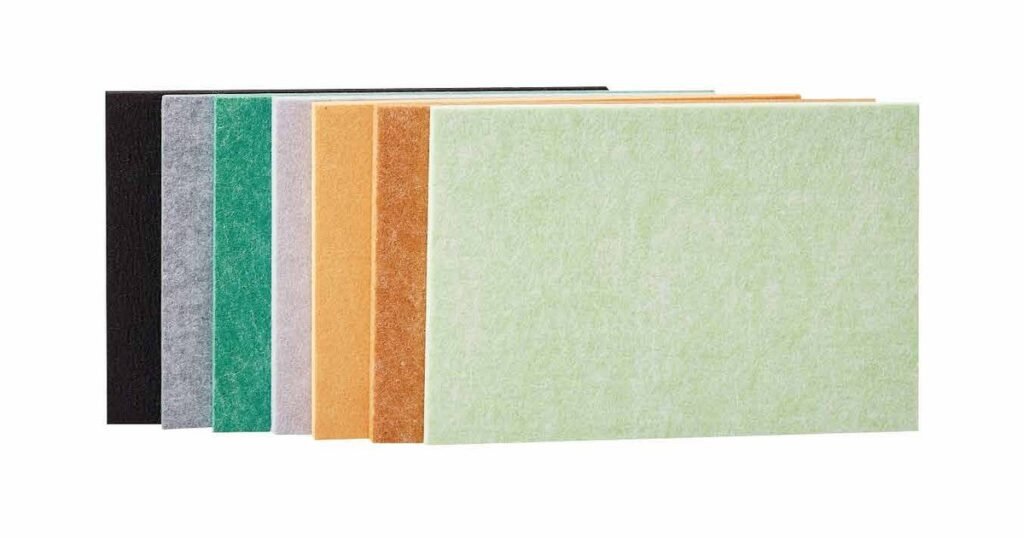
Colour is where wholesale enquiries most often go wrong. A digital swatch, PDF or photographed sample is not a reliable reference — screens and printers shift tone. Approve against a physical colour card, and where a panel runs the length of a room, require that all panels for a continuous area come from one dye lot. Engineered felt colour is far more consistent than natural materials, but batch drift is still possible on darker and saturated shades.
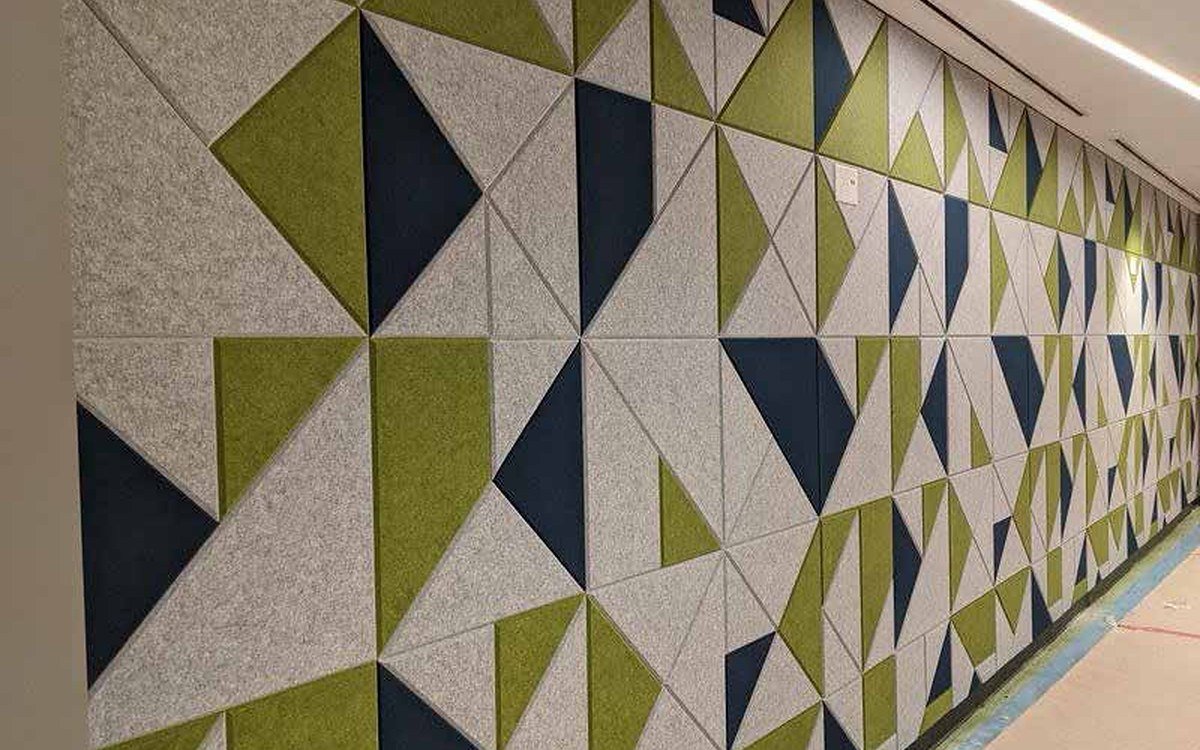
The standard card is the fastest, most economical route. If your palette demands a specific match, ask whether the supplier can make a custom-colour acoustic felt panel, what minimum applies to a dedicated dye run, and whether colour comes from dyed fibre or a surface treatment — the two have different implications for fire classification, cleanability and wear. Designers wanting pattern rather than solid colour should review the printed acoustic felt wall panel, where the print is applied to a standard panel and the acoustic core is unchanged.
Minimum order quantities by finish
Minimum order quantities are not arbitrary. They reflect the smallest run that can be set up, dyed, cut and packed without wasting more material than the order is worth. At wholesale level MOQ is usually expressed per colour, per thickness and per finish rather than as a single number. The figures below are indicative planning ranges only; actual minimums depend on current stock and line scheduling and must be confirmed in the quotation.
| Finish / configuration | Indicative MOQ | Lead-time effect | Notes |
|---|---|---|---|
| Stock colour, standard size | From ~100 m² | Shortest | Often combinable across SKUs |
| Non-stock standard colour | ~200–300 m² per colour | Adds a dye-run step | Ask if mixed colours share a slot |
| Custom colour / Pantone match | ~300–800 m² | Sample approval + dedicated run | A signed golden sample is essential |
| V-groove or CNC pattern | ~100–300 m² | Adds tooling and programming | Tool setup may be billed separately |
| Printed or private-label face | Print setup + panel qty | Adds artwork proof and print run | Sign artwork before printing |
The most useful question is not “what is your MOQ?” but “which of my SKUs can share a production run?” A distributor ordering four colours at 60 m² each may be refused, while the same 240 m² in two colours could be accepted. Ask for the MOQ logic in writing and a combined-quantity quote before dropping a colour for commercial reasons.

Private-label and OEM options for distributors
For distributors, private labelling is often the difference between selling a commodity and building a defensible range. A PET felt panel suits this well: the panel is a standard pressed product, while the elements carrying your brand — face colour, print, label, carton and documentation — can usually change without touching the acoustic core. That keeps certification risk low, provided the certificate covers the same construction you ship. Ask the factory who owns the artwork and printing plates, the minimum reorder quantity once artwork exists, and how over-run or damaged cartons are handled. Reputable suppliers hold artwork under an agreed arrangement and quote reorders without recharging setup.
A realistic OEM scope includes your logo on the label and carton, custom carton artwork and barcodes, your own installation and care literature, a colour palette for your market, and sometimes a custom face print. Usually outside scope at wholesale volume is any change to the fibre formulation, resin system or panel build-up, because each would invalidate existing test reports. Treat any offer to “make it to your spec” with a request for the exact certificate covering it. The solutions overview sets out which families can be branded and the finishing routes available.
Container loads, packing and lead time
PET felt panels are light but bulky, so a wholesale order is usually constrained by volume before weight. Panels are normally stacked flat in cartons on pallets with corner protection and stretch wrap; edge protection and moisture barriers matter more than small material savings on a long, humid crossing.
| Container | Indicative use | What to verify |
|---|---|---|
| 20 GP | Trial orders, dense panels, mixed SKUs | Pallet count, floor loading, weight ceiling |
| 40 GP | Mid-volume panel orders | Usable length after dunnage, carton orientation |
| 40 HQ | Bulky lightweight panels, maximum cube | Height use, moisture protection, stacking limits |
Lead time is a chain, not a number: sample production, approval, colour and artwork sign-off, pressing, cutting, finishing, QC and packing all sit on the critical path. Peak season and factory holidays add weeks. Shorten it by approving the physical sample and artwork early, freezing the specification and agreeing a production slot in writing. Ask for lead time measured from sample approval, not enquiry date, so quotations compare fairly. Container figures are indicative only — confirm them with your forwarder.
Application scenarios for bulk PET felt panels
Bulk PET felt panels are specified wherever a large area needs predictable absorption without a hard, reflective finish. Open-plan offices use ceiling clouds and hanging baffles to cut reverberation and speech break-up. Education and healthcare projects favour impact-resistant densities on walls and corridors, where durability and cleanability matter as much as the NRC. Hospitality and retail use colour and printed faces to turn acoustic treatment into a design feature. The logic is consistent: treat the ceiling first for broad absorption without losing floor area; use wall panels for first-reflection control and identity; reserve higher-density grades for surfaces that are touched or cleaned frequently.
Coordinate early with mechanical and electrical teams — sprinklers, diffusers and luminaires compete for ceiling space, and a late change means re-cut panels and wasted material. The solutions pages group these applications by room type as a starting point for a schedule.
A buyer’s RFQ checklist for PET felt acoustic panels wholesale
A good RFQ is a short specification exercise, not a long email. Send one document to every supplier so responses line up:
- Project location, destination port, delivery window and incoterm (ex-works, FOB, CIF or DDP).
- Total area by panel type, sheet size, thickness and nominal density, with tolerances.
- Target absorption (NRC or alpha-w) and the mounting condition assumed in the design.
- Required fire classification and standard, including smoke and droplet suffixes.
- Colour reference — physical card or signed sample — and colourways with approximate areas.
- Edge, groove or print detail, with vector artwork where relevant.
- Which SKUs can be combined in one production run.
- Packing, pallet type, carton labelling and private-label artwork requirements.
- Shipment documents: test reports, fire certificate, QC record, packing list, certificate of origin.
- Sample request: quantity, finish, courier account and the date approval is needed.
Ten lines of clarity at RFQ stage replaces weeks of clarification later. If a supplier will not comment on individual lines, treat that as a signal about how the order will be managed.
Common mistakes when ordering bulk polyester fibre panels
Most wholesale problems are predictable. First is comparing quotations on price per square metre without normalising thickness, density, mounting and incoterm — a 9 mm panel where you specified 12 mm is a different product. Second is approving colour from a screen rather than a physical sample, then finding the shade varies across a continuous wall. Third is specifying an acoustic number without the mounting condition: absorption measured over a 200 mm air gap will not be reproduced when the panel is glued directly to plasterboard. Fourth is leaving fire documentation until submittal — ask for the classification of the complete assembly, not a single-component datasheet. Fifth is underestimating peak-season effects on a fixed installation date.
Do not treat the sample as a formality. A sample box is the only point at which you can verify colour, edge quality, density by feel, print fidelity and packaging before money is committed. Approve it in writing, retain a signed copy at both ends and reference that sample number on the purchase order. It is the cheapest risk control in the process.
Request a quote and download the catalogue
If you are comparing PET felt acoustic panels wholesale for an upcoming project, send your panel schedule, colour references and target dates through the request a quote page. We will confirm which parameters can be produced at wholesale volume, minimum quantities by finish, and a lead time measured from sample approval. For specifications, standard sizes and the full colour range, download the catalogue from the resources page. Indicative figures here are planning ranges only; all densities, minimums, container quantities and lead times are subject to confirmation in a formal quotation for your exact specification and destination.
Frequently asked questions
What is a typical MOQ for PET felt acoustic panels wholesale?
It depends on the finish. Stock colours in standard sizes can start around 100 m² and are often combined across SKUs. Non-stock colours usually require 200-300 m² per colour, and a Pantone match or printed face commonly needs 300-800 m² because a dedicated run and artwork approval are involved. These are indicative ranges; confirm the minimum and which SKUs can share a run in a formal quotation.
Can a supplier match a specific Pantone or brand colour?
Often yes, but confirm how the colour is produced. Dyed fibre changes the panel itself and keeps the acoustic behaviour and fire classification intact, while a surface treatment can affect cleanability and wear. A physical sample must be signed by both parties before production, and a dedicated dye run usually carries a minimum quantity and a longer lead time. Always approve a golden sample before releasing the order.
Which documents should come with a wholesale order?
Request the absorption or NRC test report with its mounting condition, the reaction-to-fire classification for the complete assembly, the QC inspection record, a packing list with carton and pallet references, the commercial invoice and a certificate of origin where required. If you are private labelling, add the artwork approval record. Confirm that every certificate covers the exact thickness, density, felt and finish being shipped.
Does a higher-density PET panel always absorb more sound?
No. Density mainly improves stiffness, impact resistance and durability, while thickness and the mounting air gap do more for low and mid-frequency absorption. A dense thin panel glued to a wall can absorb less at low frequencies than a lighter panel mounted over a cavity. Specify absorption against the exact mounting detail, and read the full frequency-band table rather than a single NRC number.
How do I estimate how many panels fit in a container?
Start from the supplier’s real carton dimensions and pallet configuration, not panel area. Divide the container’s usable internal volume by the carton volume, allow for dunnage and pallet height, then check the weight limit. PET felt is usually volume-limited rather than weight-limited, so a 40 HQ often carries more than a 40 GP. Confirm any published figure with your forwarder and the supplier.
Can I private-label PET felt panels without losing the fire certificate?
Usually yes, provided the panel construction is unchanged. Adding your label, carton artwork, literature or a printed face to a standard panel normally leaves the tested build-up intact, but the certificate must still describe the exact assembly you ship. Ask the supplier to confirm in writing which branded elements are covered, and avoid changing the core, adhesive or backing, because those changes would require retesting.