Architects are increasingly treating acoustic surfaces as geometry rather than as flat planes: a curved reception wall, a ceiling that undulates over a concourse, a sculpted baffle cluster in an atrium. The acoustic industry has followed, and there are now several distinct ways to make a panel curve. Each has different limits, different tolerances, and a different cost structure, and choosing the wrong method for a form is how projects end up with visible faceting, cracked finishes, or a budget overrun discovered after the mock-up.
Method one: thermoforming PET felt
PET felt is a thermoplastic. Heated to a controlled temperature, it becomes pliable, can be formed over a mould, and holds its shape on cooling. This is the most direct route to a genuinely curved felt panel, and it produces smooth, continuous curvature without visible joints. The limits are practical: the radius achievable depends on panel thickness (thinner panels form tighter curves), the panel must be formed over a mould built for the purpose, and the tooling cost is only justified when a shape repeats.
Thermoforming also changes the material slightly: the formed area compresses, so density and thickness vary subtly across a curve. For acoustic purposes this is generally acceptable, but where a project requires uniform performance across a large curved surface, the variation should be discussed rather than assumed. Fire performance of formed panels is normally unchanged, but the supplier should confirm it for the specific product and forming temperature.
Method two: kerf-bending wood slats
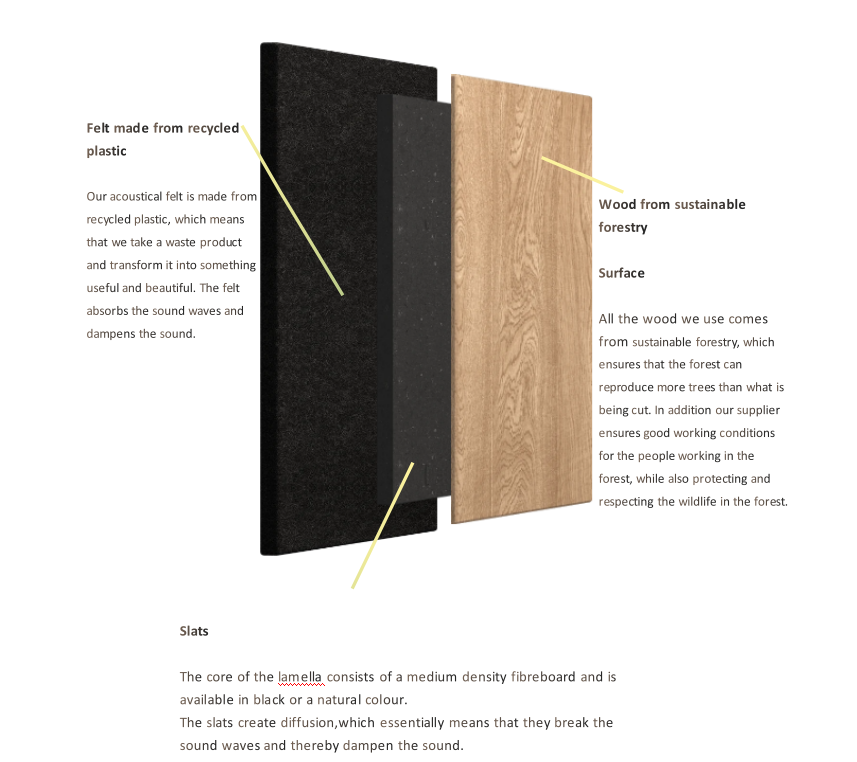
Wood slat panels can follow a curve by kerfing the backing — cutting a series of closely spaced grooves that allow the panel to bend — or by building the curve from short slat segments on a curved substrate. Kerf bending produces a smooth curve on a felt or flexible backing but reduces the panel’s rigidity and can show the kerf lines on the back face; segment building preserves rigidity but reveals faceting unless the segments are short enough to read as a continuous curve.
The practical limit for kerf bending is a radius of roughly 300 to 500 mm on a standard panel thickness, depending on the backing. Tighter radii require a purpose-made curved substrate, which moves the panel from a product into a fabrication. Projects with repeated curved elements — a colonnade, a series of bay windows — justify the tooling; one-off organic forms usually do not.
Method three: faceted and modular approaches
Many “3D” acoustic surfaces are not curved at all but faceted: flat panels set at varying angles to create an undulating or crystalline surface. This is often the most economical route to a sculptural ceiling or wall, because standard panels and standard fixings can be used with a designed sub-frame. The acoustic behaviour is also predictable, since each facet is a known flat absorber at a known angle.
Faceted systems require careful setting-out and a sub-frame that can hold each panel at its intended angle. The visual risk is that the design intent — a smooth wave — reads as a series of kinks if the facet size is too large relative to the viewing distance. A useful rule: facets should be small enough that at the closest viewing distance the eye resolves them as a surface, not as individual planes.
Method four: CNC sculpting and lattice work
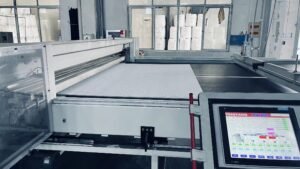
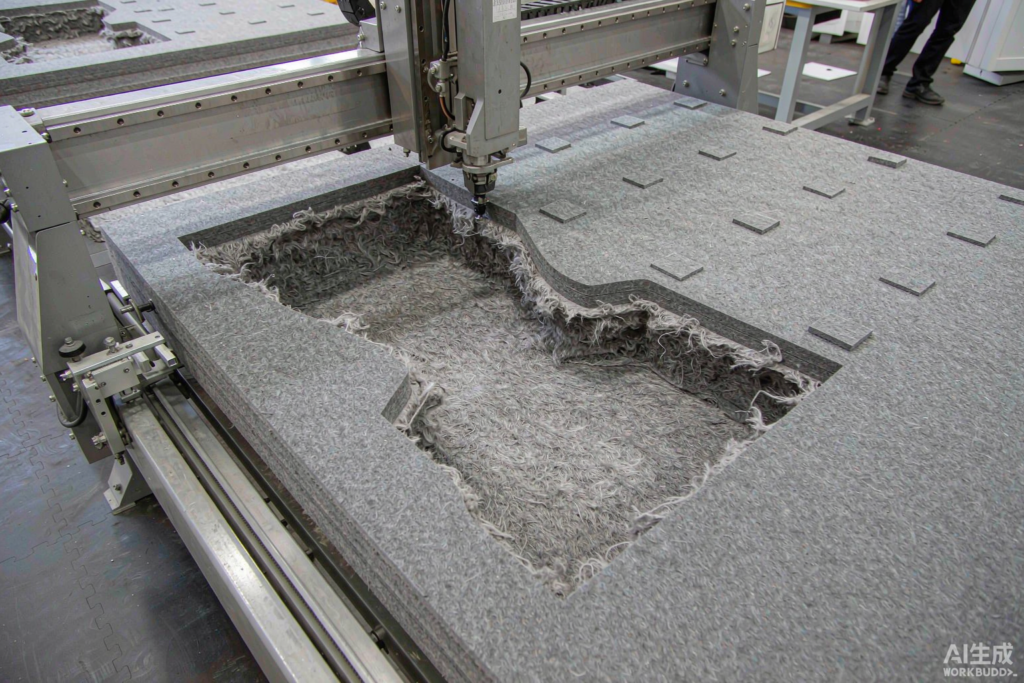
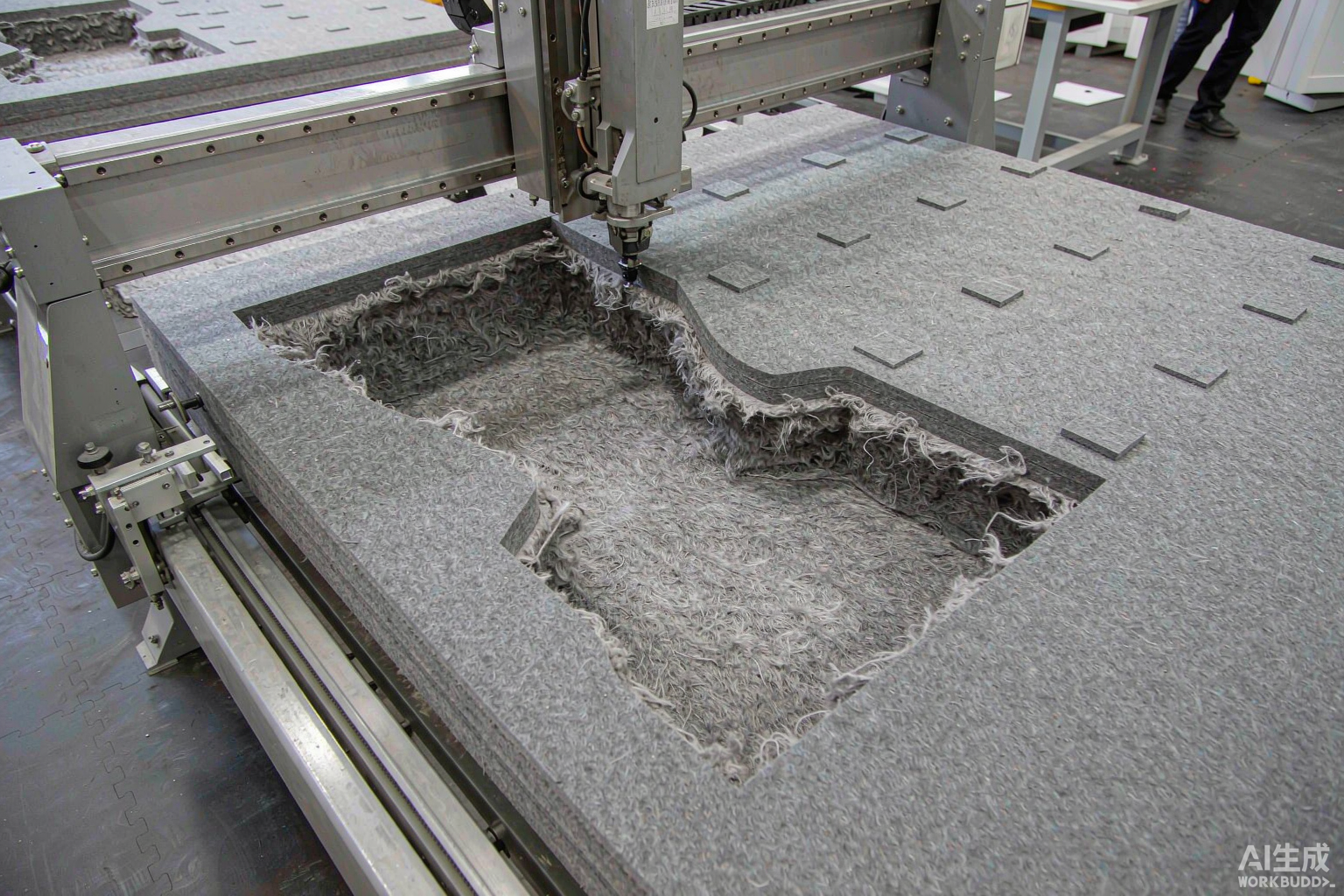
Thick felt can be cut into lattice patterns, wave profiles, and figurative shapes on a CNC router, producing depth through cut-outs rather than through bending. This is where felt’s machinability becomes an acoustic asset: a deep cut-out both creates visual depth and increases exposed surface area, which can raise absorption slightly. The limits are structural — a heavily cut panel loses rigidity and needs a backing or frame — and visual — cut edges must be clean, which depends on tool sharpness and feed rate.
Cost in this method scales with cut length rather than with panel area, which is why open, simple patterns are dramatically cheaper than dense, intricate ones. Designers who understand that relationship can iterate a pattern toward something both buildable and affordable without changing the visual language.
Specifying curved work without surprises
Four items should be settled before a curved panel goes into a tender. First, the method, stated explicitly, because a price for thermoformed felt and a price for faceted standard panels are not comparable. Second, the tolerance: how much deviation from the intended curve is acceptable, and how joints between curved and flat elements will be resolved. Third, the mock-up: a full-size sample of the curve, viewed under the project lighting, is the only reliable way to judge whether faceting or surface variation is acceptable. Fourth, the fixing: curved panels need a sub-frame that holds the form, and that sub-frame is part of the system, not an afterthought.
When those four are clear, curved acoustic work is a normal construction activity with predictable cost. When they are not, it becomes an experiment conducted at the client’s expense — and the most common outcome is a wall that is acoustically correct and visually almost right, which is the hardest kind of defect to resolve.
When to change the design instead of the process
Some curved briefs are better solved by adjusting the geometry than by adding tooling. A radius that requires thermoforming at 300 mm may become a faceted curve at 600 mm facets that reads acceptably at the viewing distance and costs a fraction as much. A continuous wave ceiling may become a series of angled planes that produce the same visual rhythm with standard panels. Designers who are willing to iterate on the geometry against the manufacturing reality usually get a better result than those who hold the form and pay for tooling.
The conversation works best early, before the design is fixed in a tender package. A manufacturer who sees a curved form at concept stage can propose two alternatives — one that matches the intent at lower cost, one that matches it exactly at higher cost — and let the client choose with accurate numbers. A manufacturer who sees it at tender stage can only price what is drawn, which is usually the expensive version.
There is also a maintenance dimension that curved work often ignores. A sculpted or faceted ceiling accumulates dust on upward faces and is harder to clean than a flat plane; a deep cut-out pattern in felt requires vacuuming inside the cut-outs. Facilities teams discover this after handover, when the cleaning regime has to be re-planned. Specifying accessible shapes, or accepting a slightly higher cleaning frequency, is worth discussing while the design is still fluid.
The final practical point is spares. Curved and sculpted panels are made in batches, and a damaged piece years later may require re-tooling. Clients should hold a small spare stock of the formed elements — typically two to five percent — and the manufacturer should archive the forming data. It is a cheap insurance policy on an expensive custom element, and it is the difference between a repairable wall and a permanent defect.