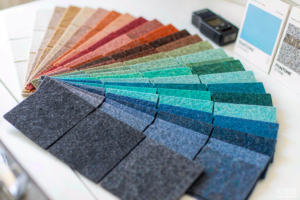
Among PET acoustic panel buyers, one question decides more quotations than any other: which thickness? The industry has settled on three standard gauges — 9mm, 12mm and 24mm — and each occupies a distinct role in the market. Choosing correctly means matching performance to application without paying for absorption you do not need.
9mm: the economical workhorse
At 9mm, PET felt delivers meaningful mid-to-high frequency absorption at the lowest cost and weight per square meter. Typical performance sits around NRC 0.60–0.70 when mounted directly to a wall. Best uses:
- Corridors, lobbies and back-of-house areas with moderate noise
- Large-format decorative wall coverage where budget is the constraint
- Layered applications — as the felt backing behind wood slats
Its limit is low frequency: thin panels do little against the 125–250 Hz energy that dominates speech-heavy rooms.
12mm: the market standard
12mm is the volume leader in commercial interiors, and for good reason. Absorption climbs to roughly NRC 0.80–0.85 in direct mounting, weight stays manageable for adhesive or z-clip installation, and the material still cuts cleanly for CNC shapes and edge details. Offices, classrooms, meeting rooms and hospitality projects are its natural territory. For most buyers, 12mm is the default answer to “which panel for a normal commercial room”.
24mm: the acoustic specialist
Doubling the thickness changes physics. 24mm panels reach NRC 0.85–0.90+ and — more importantly — push useful absorption down into the 250 Hz band where offices, studios and multipurpose rooms struggle. Applications:
- Video-conference and meeting rooms, where speech clarity is the product
- Music rooms, studios and home cinemas
- Spaces where no air gap is possible, so the panel itself must carry low-frequency performance
It costs more per square meter and weighs roughly double 12mm — a fair trade wherever sound quality, not decoration, drives the project.
The air-gap multiplier
Whatever the thickness, mounting matters: adding a 25–50mm cavity behind the panel dramatically improves low-frequency absorption. A 12mm panel on furring can outperform a 24mm panel glued flat — the cheapest acoustic upgrade available.
Choosing in one sentence
Budget coverage → 9mm; general commercial rooms → 12mm; speech-critical and music spaces → 24mm; and wherever the frame allows it, add an air gap. MST Acoustics produces all three thicknesses with per-frequency ISO 354 data for each mounting condition — tell us the room type and we will recommend the most economical panel that meets its target.