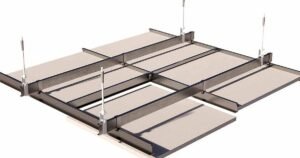

A supplier replies to your RFQ with one line of acoustic data — NRC 0.85 — and asks you to confirm the schedule. The number looks strong. Then a colleague asks which mounting condition it was measured under, whether the test followed ISO 354 or ASTM C423, and whether the same figure applies to the 9 mm variant you actually want to buy. Nobody can answer, and the submittal is due in two weeks. Enquiries about an NRC 0.85 acoustic panel test report go wrong at exactly this point: the figure is real, but it answers a narrower question than most buyers assume. This guide is for architects, acoustic consultants, main contractors, distributors and procurement managers who need to verify a supplier’s absorption data before it becomes a contractual specification.
We write from the supplier side, for people who sign off schedules rather than treat a room with foam tiles. The figures and ranges below are indicative planning guidance — illustrative values that explain method, not data for any specific product. The report and quotation issued for your exact construction are the controlling source. We reproduce no certificate numbers or named reports here; those must come from the manufacturer. For product context, see the PET felt and fabric panel category.

Why an NRC 0.85 acoustic panel test report is not a pass/fail number
NRC, the Noise Reduction Coefficient, is a single-number summary of how much sound a material absorbs, averaged across a few mid-frequency bands on a scale from 0.00 (reflective) to 1.00 (fully absorptive). A value of 0.85 means that, in the bands averaged, the tested sample absorbed roughly 85 percent of the incident sound energy under the conditions of the test.
That last clause matters more than the number. NRC is not an intrinsic property like density or thickness. It is a result from a specific sample, thickness, density, mounting, laboratory and method. Change any input and the figure can move. A number quoted without them is not so much wrong as incomplete — and an incomplete figure is hard to defend when an approver asks how it was derived.
So treat the number as the headline of a data set. Your job is to confirm that the test behind it describes the product, thickness, finish and mounting you intend to install. Application notes using the same supplier-side approach sit under solutions.
What the ISO 354 acoustic test actually measures
The standard behind most absorption claims in Europe and Asia is ISO 354, “Acoustics — Measurement of sound absorption in a reverberation room.” In North America the equivalent framework is ASTM C423. Both are laboratory methods, measuring absorption in a reverberation room rather than in an occupied space.
A sample of known area is placed in the room; reverberation time is measured with and without it. From the change in decay, the equivalent absorption area is calculated and divided by the sample area to give a coefficient for each band. Those band coefficients are the raw data; NRC, SAA and alpha-w are summaries calculated from them afterwards.
- Sample area and room size. Results depend on sample area, room volume and diffusion. Standards set minimums so results from different laboratories stay comparable. An unusually small sample can produce an unreliable coefficient, especially at low frequencies.
- Mounting is part of the result. The sample is mounted in a defined way — against a reflective surface or spaced off it to form a cavity. The condition is written into the report because it changes the outcome.
- The result belongs to one construction. Facing, core, backing, thickness, density and any finish are all part of what was tested. A report for 24 mm does not describe 9 mm.
Reading the absorption coefficient data behind the single number
Before judging an NRC claim you need the octave-band coefficients it was calculated from. NRC averages 250, 500, 1000 and 2000 Hz. Two panels can produce the same average while behaving very differently where speech lives. The table uses illustrative, indicative coefficients to show why. These are teaching values, not measurements of any MST product.
| Octave band (Hz) | Panel A — indicative coefficient | Panel B — indicative coefficient | What differs in practice |
|---|---|---|---|
| 125 | 0.20 | 0.55 | Panel B absorbs far more low-frequency energy; relevant to plant rooms and traffic noise. |
| 250 | 0.45 | 0.75 | Speech fundamental energy; important for meeting rooms and classrooms. |
| 500 | 0.95 | 0.90 | Both strong through the speech intelligibility range. |
| 1000 | 0.98 | 0.90 | Both strong; differences here are usually marginal. |
| 2000 | 1.02 | 0.85 | Coefficients above 1.00 can occur in reverberation room tests; see the note below. |
| NRC (avg. 250–2000 Hz) | 0.85 | 0.85 | Identical headline, very different low-frequency behaviour. |
Two details matter. The averages above are identical to two decimals, so a schedule saying only “NRC 0.85” cannot distinguish these panels. Second, coefficients above 1.00 are a known feature of reverberation room measurement and are reported as measured, not clamped to 1.00.
Request the full band table alongside the average and compare the bands that matter. For speech clarity, look at 250 and 500 Hz; for plant-room rumble, the 125 Hz row decides whether the panel helps.
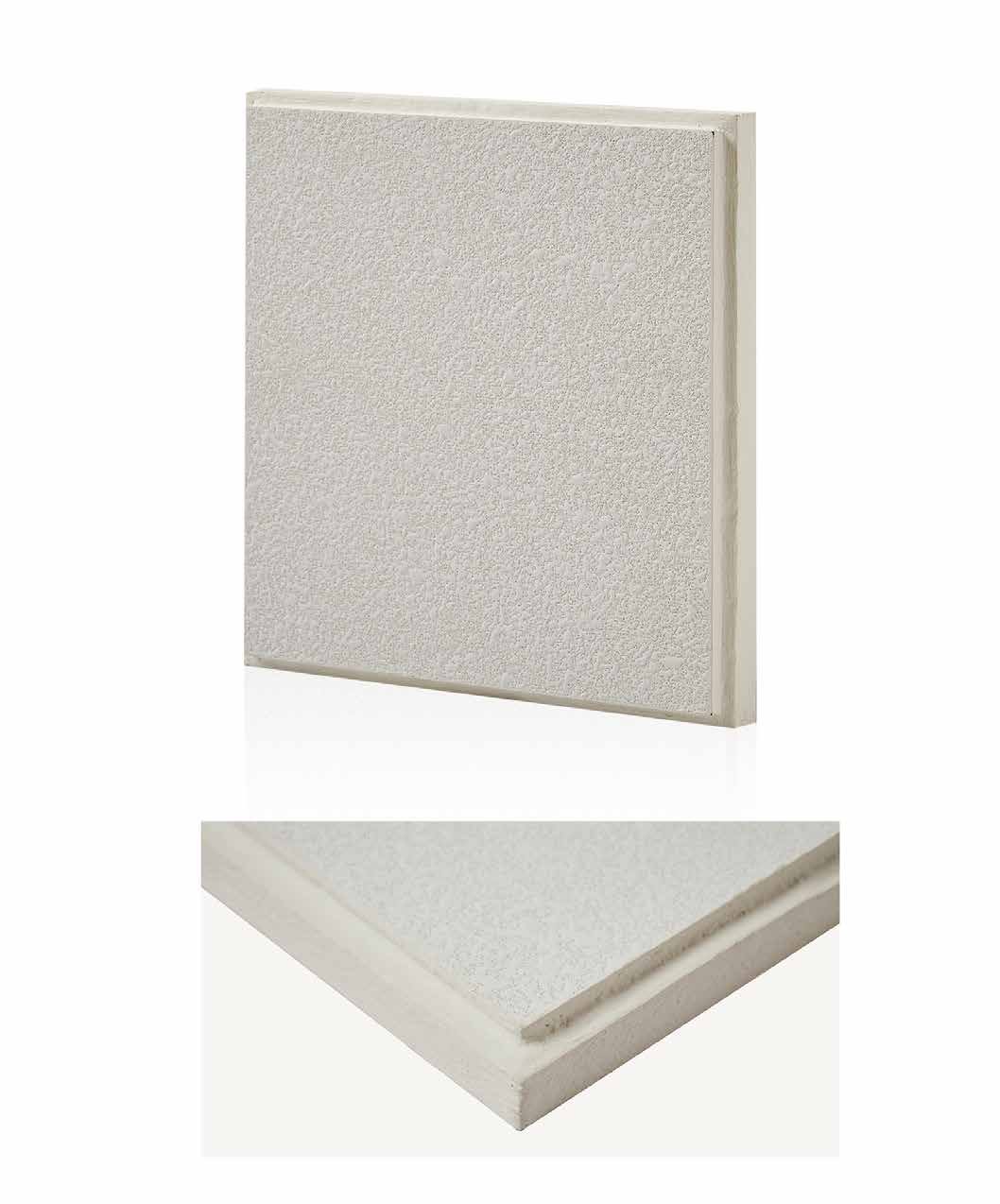
How mounting and air gaps change the number you receive
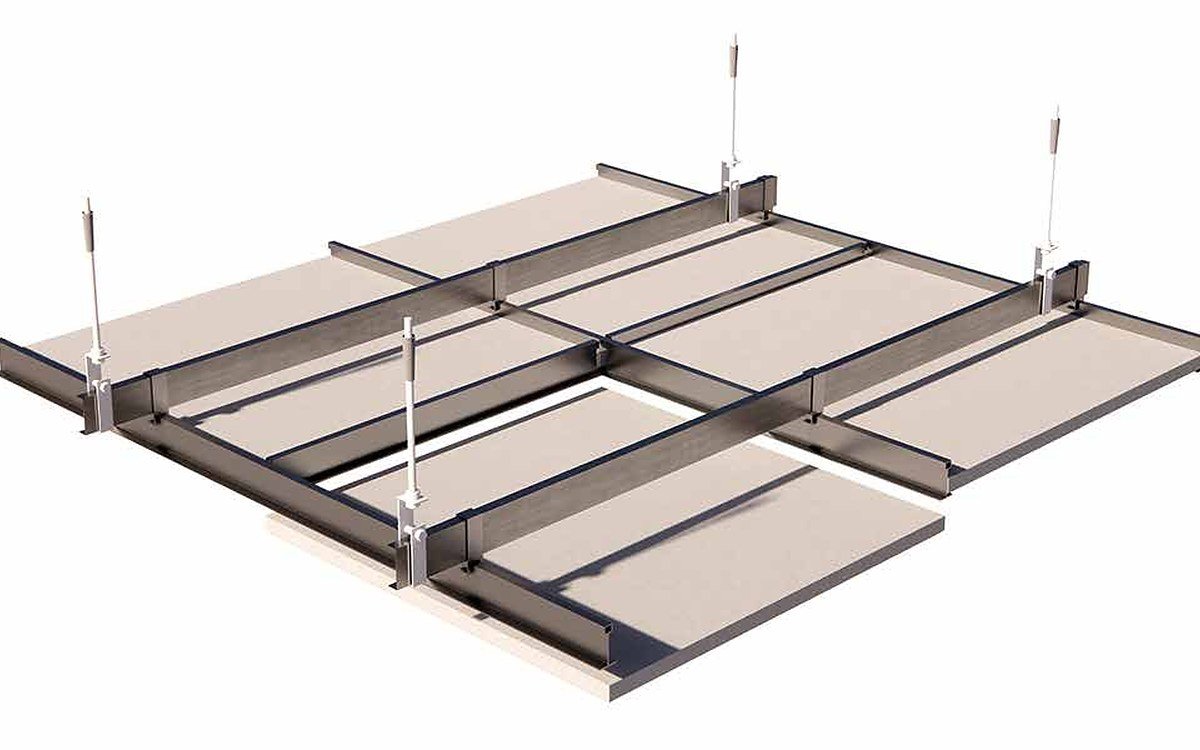
Mounting is the variable buyers most often overlook and the one most likely to cause a site shortfall. A panel fixed flat to a solid wall works mainly in the upper bands. The same panel spaced off the wall with a sealed cavity gains low-frequency performance; the deeper the cavity, the lower the frequency of that gain.
Reports use a mounting notation so this is unambiguous — Type A or E-100 for material on a reflective surface, or designations such as D-50 and E-400 for an assembly with a stated air gap. The code depends on the standard, but the principle is constant: it describes how the sample sat in the room, and the result is valid for that arrangement only.
| Mounting condition (indicative) | Typical notation | Effect on low-frequency absorption | Buyer check |
|---|---|---|---|
| Directly on a solid backing | Type A / E-100 | Lowest low-frequency gain; performance concentrated mid/high. | Use the figure only if your fixing is also direct. |
| Small cavity, roughly 50 mm | D-50 / E-200 | Modest improvement around 250 Hz. | Confirm the cavity is sealed and uninterrupted. |
| Deep cavity, roughly 400 mm | E-400 | Marked low-frequency gain; resonances shift downward. | Verify the suspension delivers this depth. |
The failure is predictable. A consultant selects a panel for its strong 125 Hz result over a 400 mm cavity; the contractor, blocked by services, fixes it flat. Same product, correct invoice, but the low-frequency absorption the design relied on is gone. Write the mounting condition into the schedule and check it at shop-drawing stage.
NRC 0.85 acoustic panel test report vs SAA and alpha-w: do not convert between systems
Buyers often assume the single-number systems are interchangeable and that an NRC 0.85 panel can be relabelled as an equivalent SAA or alpha-w value. It cannot. They average different bands, use different rounding and come from different standards. They can be quoted side by side for the same product, never converted by a formula.
| System | Standard / region | Bands used | How to use it |
|---|---|---|---|
| NRC | ASTM C423 convention, quoted globally | 250, 500, 1000, 2000 Hz | Quick mid-frequency summary; still the most requested figure. |
| SAA | ASTM C423, North America | Twelve one-third-octave bands, 200–2500 Hz | Finer average; usually reads slightly higher than NRC. |
| alpha-w (àw) | EN ISO 11654, Europe | Weighted curve over the speech range | European metric; may carry shape indicators L, M or H. |
An SAA of 0.90 does not mean a panel is “better” than one at NRC 0.85 — they may be the same product summarized two ways. If a tender names a system, request that system’s value from the lab report. For international teams, ask for all values available for the same construction. That is the safest way to make an NRC 0.85 acoustic panel test report useful across regions.
Why a laboratory NRC 0.85 does not guarantee your room’s RT60
The costliest misunderstanding in acoustic procurement is the leap from a material’s absorption coefficient to a room’s reverberation time. NRC describes a sample in a reverberation room. RT60 describes how long sound takes to decay in your finished, furnished, occupied space.
Room reverberation depends on total absorption — every surface area times its coefficient, plus people and furniture — and on volume and distribution. A high coefficient over a small area may barely change RT60; a moderate coefficient well distributed across a ceiling can transform a room. No responsible supplier promises a target RT60 from a datasheet alone. Treat early figures as indicative and require a room calculation with actual areas, volumes and occupancy.
Red flags in a supplier absorption data sheet
Once you know what a complete data set looks like, unreliable claims are easy to spot. Act on these before a figure reaches a tender:
- A single number with no band data. Without the coefficients the average cannot be checked or compared.
- No mounting condition stated. The result is not specific enough to reproduce on your project.
- No thickness, density or construction. “PET panel, NRC 0.85” without thickness is not a specification.
- Impedance-tube results presented as NRC. Tube tests measure small samples at normal incidence; they are not a substitute for reverberation room results.
- No laboratory or method identified. An unnamed source cannot be verified.
- Vague wording such as “up to NRC 0.85.” The qualifier almost always refers to the best-case variant.
None of these proves a product is poor. They show the seller has not given you enough to verify the claim — reason enough to ask again.
A verification and RFQ checklist before you specify
Build these requests into every enquiry so suppliers answer the same questions, saving weeks of clarification and making quotations comparable:
- Test method and laboratory. The standard used, the testing body and the test date.
- Full absorption coefficient table. Band values across the range, not just the single-number rating.
- Tested construction. Thickness, density, facing, core, backing and finish, each checked against your schedule.
- Mounting condition and air gap. The exact notation, matched to your fixing detail.
- All available single-number systems. NRC, SAA and alpha-w where they exist, tied to the same test.
- Sample and written confirmation. A sample of the exact variant, plus confirmation that the data covers your colours and sizes.
Keep replies in one folder, indexed against the panel schedule. That index lets an approver trace every claimed value to its source. Downloadable data sheets sit on our resources page, and a sample request can start through the contact page.
Where this verification discipline matters most
The cost of an unverified figure is highest in rooms with a defined acoustic target. In offices and classrooms, speech clarity depends on mid-frequency absorption and panel placement. In auditoria, low-frequency behaviour and the absorption–diffusion balance make band data essential. In healthcare and education, finishes must satisfy hygiene and fire requirements alongside the acoustic target; a change of facing can alter both the fire classification and the absorption result. The discipline is the same — verify before you write the number, then detail the installation to match the test. Browse representative finishes in the custom colour acoustic felt panel range when matching a schedule to a product.
Request the data behind the number
An NRC 0.85 acoustic panel test report is useful precisely when treated as a data set rather than a badge. Ask for band coefficients, mounting condition, tested construction and method; check them against the product and fixing detail on your drawings; keep the package indexed against the schedule. If a supplier cannot produce those documents, that is a commercial signal as much as a technical one. To request full absorption data and test documentation for a specific panel, request a quote with your sizes, finish and mounting detail. To review product data first, download the catalogue.
Frequently asked questions
What does an NRC 0.85 acoustic panel test report actually tell me?
It gives the average absorption across four mid-frequency bands (250, 500, 1000 and 2000 Hz) for one specific sample, thickness, construction and mounting, under a named method. It does not predict your room’s performance or low-frequency behaviour. Always request the full band table and mounting condition.
Can I convert NRC 0.85 into SAA or alpha-w?
No. The systems use different bands, numbers of bands and rounding rules. They can be reported side by side for the same product, but there is no reliable conversion formula. If your tender names a system, ask the laboratory or supplier for that value directly.
Why does the mounting condition matter so much?
Because absorption, especially at low frequencies, depends on what sits behind the panel. A sample tested over a deep cavity can show strong 125 Hz absorption that disappears when the panel is glued flat to a wall. Match the report’s mounting notation to your fixing detail.
Does NRC 0.85 mean my room will reach its target RT60?
Not by itself. RT60 depends on total absorption — every surface area times its coefficient, plus occupancy and furniture — and on room volume and distribution. A high coefficient over a small area may barely change RT60. Require a room calculation using your actual areas and finishes.
Why do some absorption coefficients appear above 1.00?
In a reverberation room, the measured equivalent absorption area can slightly exceed the geometric sample area because of edge effects, producing coefficients just above 1.00. This is normal, is reported as measured by reputable laboratories, and is handled by defined rounding rules.
What documents should I request from a supplier before specifying?
Ask for the test method and laboratory, full band coefficients, tested construction, mounting condition and air gap, all single-number systems for that same test, a sample of the exact variant, and written confirmation that the data covers your colours and sizes.