Search for sound absorption online and you will find pyramid-shaped acoustic foam everywhere. It is cheap, light and instantly recognizable — which is exactly why professional buyers keep receiving questions about it. Acoustic foam and architectural acoustic panels overlap in function but differ sharply in everything that matters for a commercial project: verified performance, fire compliance, durability and design.
Myth 1: “Foam absorbs just as well if it’s thick”
Open-cell polyurethane foam does absorb sound — in the mid and high frequencies, and mostly when thick enough. But its performance collapses at low frequencies, where the reverberation problems of real rooms actually live. A 50mm foam tile does little for the 125–250 Hz energy that makes a meeting room sound muddy. Engineered PET panels — especially 24mm — and cavity-backed systems hold far more useful absorption in the speech band, which is what offices, classrooms and restaurants actually need.
Myth 2: “Fire ratings are the same”
They rarely are. Cheap imported foam frequently ships without any fire documentation, and untreated polyurethane foam is combustible with high smoke production. In commercial interiors, building codes require documented surface-burning characteristics — EN 13501-1 in Europe, ASTM E84 in North America. Professional PET acoustic panels come with tested classifications (our panels reach EN 13501-1 B-s1,d0); asking a foam supplier for the same paperwork often ends the comparison.
Myth 3: “Foam looks fine in offices”
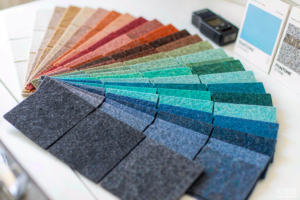
Pyramid and wedge foam reads as “recording studio decoration” — in a boardroom or hotel lobby it undermines the interior design rather than serving it. Architectural panels exist partly to solve this perception problem: PET felt panels come in dozens of colors and clean geometries, and wood slat panels bring natural material warmth. Acoustics that clients can see as design are acoustics that get specified again.
Myth 4: “Foam is cheaper, so it’s more profitable”
Unit price is not margin. Foam’s short life in public spaces (discoloration, crumbling, dust adhesion), its compliance gaps and its weak low-frequency data generate callbacks, disputes and lost reputation. Panels specified with correct data pass submittals the first time and keep performing for the life of the fit-out.
Where foam still makes sense
Foam remains a legitimate tool for non-code spaces: server rooms, machine enclosures, practice booths and budget home studios. Professionals should keep it in that box — and educate customers about why commercial projects need documented products instead.
The MST Acoustics position
Our product families — PET wall panels, ceiling baffles and wood slat systems — exist precisely for projects that demand verified absorption (ISO 354), tested fire performance and interior-grade aesthetics. When a customer asks about foam, hand them the comparison data: the panel usually sells itself, and your project sells the next one.