Buying industrial products from the other side of the world requires trust in a process most buyers never see. At MST Acoustics we think the process should be visible — because a partner who understands each step plans better, worries less, and spots the moments where their input matters most. This is the complete journey of an MST order, from the first inquiry to the last panel on the wall, told without the marketing varnish.
Step 1: Inquiry and quotation
An order begins with a conversation, not a catalog. The sales team gathers the essentials — products, quantities, colors, destination port and deadline — and the Spec Desk joins when a project carries acoustic targets or tender documents. Quotations return within days, with the detail that matters: unit prices by configuration, packing data for freight calculation, lead times per production mode (stock, standard, custom), and the document package available for the project. Hidden fees are a trust tax; we price transparently instead.
Step 2: Sampling and approval
For standard configurations, existing samples ship immediately from stock. For custom colors, veneers or CNC geometries, the lab produces pre-production samples — the physical contract for everything that follows. Approval is recorded in writing with color values where relevant, and retained samples enter the factory’s reference library, where they anchor batch consistency for reorders years later.
Step 3: Production scheduling
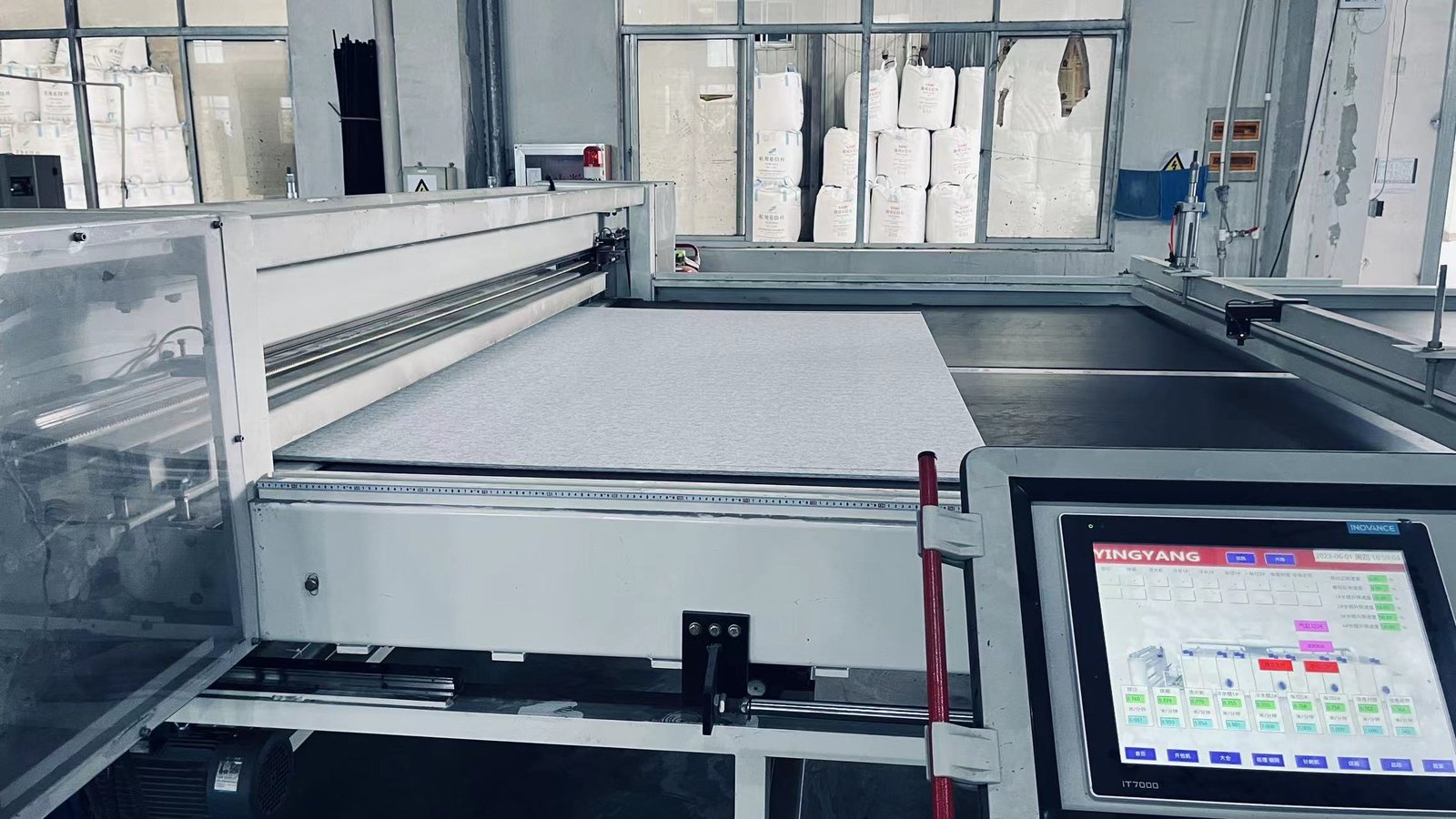
Approved orders enter the production calendar against the mode they require: Quick-Ship stock lines release from the warehouse; standard lines take production slots; custom programs sequence through lab work first. Every confirmation carries a production date we defend — and when the calendar and reality ever diverge, partners hear in weeks, not days. Mixed orders (panels, baffles, slats, hardware) are consolidated deliberately, because one container of matched goods beats three partial shipments.
Step 4: Quality control
Production and QC run in parallel, not in sequence. Incoming materials are verified (recycled fiber documentation, E1/E0 board certificates, veneer batch tone); in-process checks cover color against retained samples, density and thickness spot checks, and adhesion pull-tests on veneered products. Third-party pre-shipment inspections are welcomed for partners who run them — a confident factory treats an external inspector as free validation.

Step 5: Packing and shipping
The upgraded export packing system wraps every stack in moisture barrier, guards every corner, palletizes to specification and braces the container — then photographs all of it. The pre-loading photo set reaches the customer before departure, so receiving teams know exactly what to expect. Documents travel digitally: commercial invoice, packing list, certificates of origin and the project’s technical document pack. Freight milestones are shared so the importer’s calendar, not just the cargo, stays on schedule.
Step 6: Arrival, installation and after-sales
The journey ends at the site, but the relationship does not. Installation support runs through the Spec Desk — fixing schedules, layout questions, video guides. Claims, rare at our damage rate, follow a defined path: photographs within 14 days, replacement in the next shipment. And the reorder conversation is where the journey proves its value: retained samples and archived schedules make the second container match the first — the consistency that turns a transaction into a program.
That is the whole journey: six steps, each with a named owner, a document trail and a service promise. Partners who want to see any step in person are welcome on the factory floor — where the process looks exactly like this article says it does.
After Dispatch: Delivery, Support, and the Feedback Loop
The journey does not end at the port of discharge. Every shipment travels with the document set customs and the end client need – commercial invoice, packing list, certificates, and the packing specification – and the tracking milestones continue to the delivery address. On arrival, the carton labels tie each box to the packing list line, so site teams verify counts before opening anything, and the installation guides included in every order are written for the crew actually holding the drill, with substrate-specific fixing details rather than generic diagrams. When a question does arise mid-installation, the support desk’s duty line answers it while the crew is still on the wall – because an answer tomorrow is a claim, while an answer now is a service call that costs nothing.
Feedback closes the loop, and the company treats it as production data rather than courtesy. Every field report – praise, complaint, or photograph – is logged against the order and reviewed in the weekly quality meeting; several of this year’s improvements to packing, documentation, and panel edges began as a distributor’s site note. Distributors receive a structured check-in after first deliveries and after first installations, partly to catch issues early and partly to build the case-study library that helps them sell the next project. The journey is deliberately designed so that the last experience – installation day – reinforces the first one: a product that arrives as documented, installs as illustrated, and performs as tested.
Making the First Order Easy
Teams ordering for the first time consistently need the same three things, and the journey provides them by default: a sample pack to approve colour and texture physically; a specification package with the certificates their consultant will request; and a quotation that itemises panels, fixings, and freight so nothing hides in a lump sum. Minimums are set low for first orders deliberately – the relationship is proven in production, not in the proforma. Distributors starting out are paired with an account manager who walks the first order through each stage, and the order-tracking link they receive at dispatch becomes the template for every order after. The measurable result across existing partners: repeat orders arrive with fewer questions each cycle, because the journey teaches itself – and the team’s job is to keep it that honest as volume grows.
Key Takeaways
- Documents, tracking, and installation guides travel with every shipment to the delivery address.
- The support desk answers installation questions while the crew is still on the wall.
- Field feedback is logged as production data – several improvements began as distributor notes.
- First orders need three things by default: samples, certificates, and an itemised quotation.
What holds the whole journey together is traceability. Every order carries a reference that follows it from quotation through production, packing, shipping, and installation support, and every document generated along the way files under it – which is why nothing gets lost and nothing gets asked twice. Partners can see the same reference from their side, so a conversation about any stage starts from shared facts rather than from memory. It is a small discipline with a large effect: order journeys that once depended on one person’s inbox now survive holidays, staff changes, and volume peaks without slipping. Distributors evaluating suppliers rarely ask about traceability directly, but they feel its absence in every lost email and repeated question – and they feel its presence as the quiet confidence of a relationship that always knows where things stand.