
A university faculty building completed in the 1990s had a 600-seat lecture hall that had never worked acoustically. Hard plaster walls, a concrete soffit, a timber floor, and a rake that threw sound toward the rear made speech intelligible only in the first ten rows; lecturers reported vocal strain within a single session, and the room’s recording system picked up a persistent tail on every syllable. Measured reverberation time in the occupied condition was 2.4 seconds at mid frequencies — roughly four times what a room of that type should have.
The brief and the constraint
The faculty’s requirement was straightforward and, in practice, difficult: bring the hall to a reverberation time of about 0.9 seconds without changing the architecture, without losing seats, and without disrupting teaching. The third constraint dictated the programme: all work had to happen in a ten-week summer window, with the room handed back before the autumn term.
Two further constraints shaped the design. The hall is listed internally for its concrete soffit, so no fixings could penetrate the ceiling structure without approval; and the ventilation strategy depended on the ceiling void, meaning any treatment had to work below the soffit rather than within it.
The acoustic design
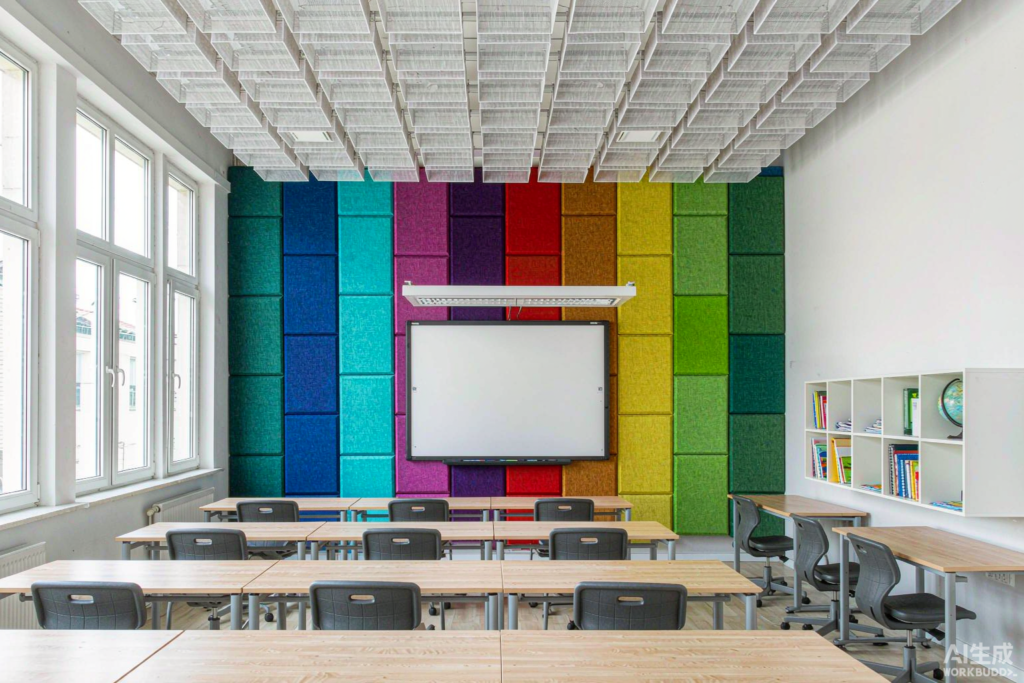
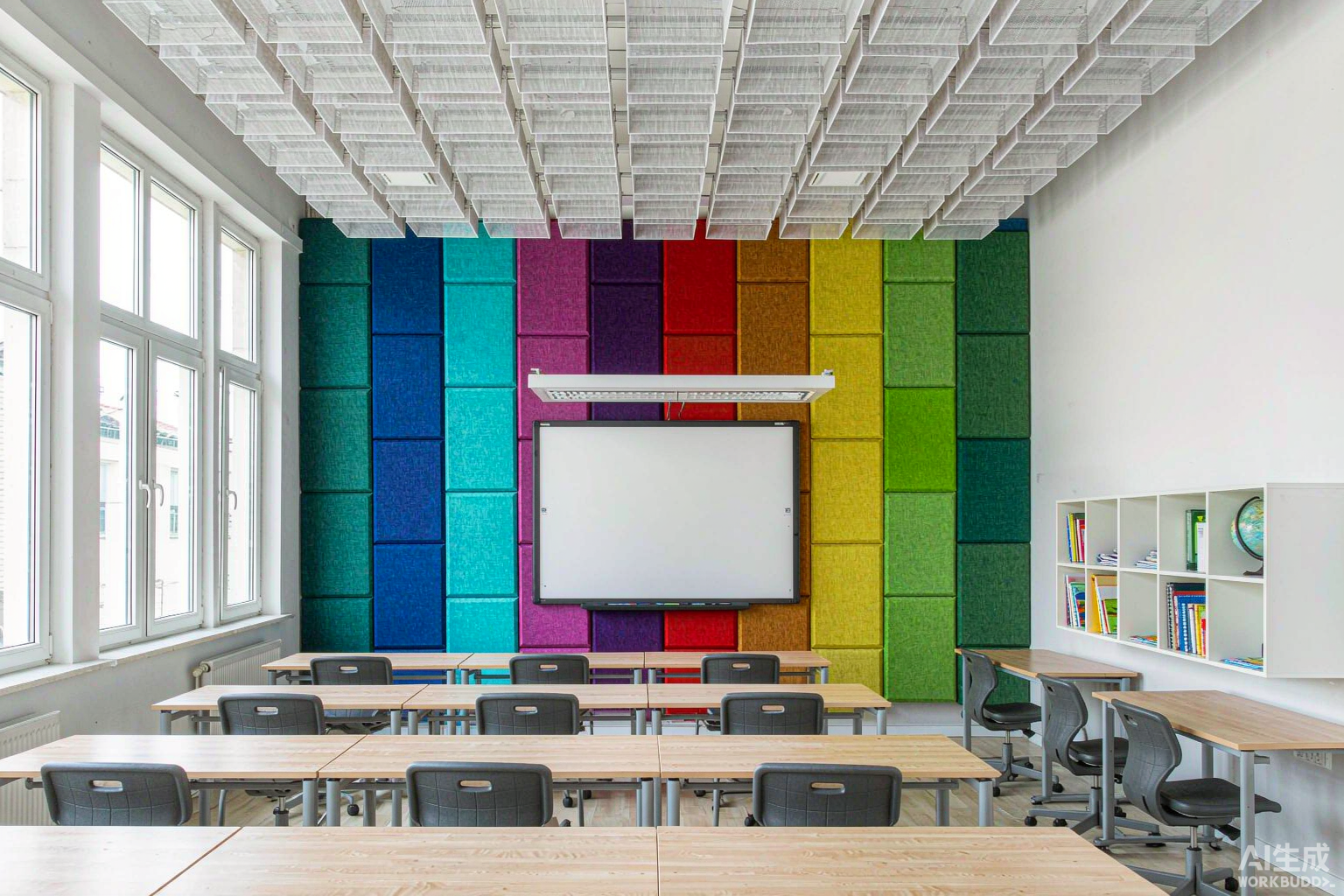
The consultant modelled the room and established that approximately 320 square metres of absorption with a coefficient of 0.85 or better in the speech band would achieve the target. Distribution was then designed around the constraint set: suspended absorptive baffles in the upper volume, hung from the roof structure on cables rather than from the soffit, providing two-faced absorption without touching the listed concrete; and 24 mm PET felt panels on the rear wall and the side walls above door height, direct-fixed on a 40 mm cavity to extend performance into the lower mid bands.
The rear wall treatment was the single most important element. The rake of the seating throws direct sound toward the back, and the untreated rear wall returned it to the stage as a delayed echo. Covering the rear wall with high-density felt at 24 mm reduced both the echo and the low-frequency buildup that had made amplified speech sound muddy.
Installation over a summer window
Installation ran to a twelve-week programme compressed into ten by working two shifts in the final month. The baffle field was installed first, using mobile scaffolding, because it was the longest single activity and the one most dependent on access to the roof structure. Wall panels followed, installed by a two-person crew on a scissor lift, with panels pre-cut to surveyed dimensions so that no cutting happened in the hall.
Two details protected the programme. All panels were pre-finished and pre-cut at the factory, so the hall never contained a cutting operation or a wet trade. And the fixing system was mechanical throughout, which meant installation could proceed in parallel with the electrical works finishing the lighting replacement — a sequencing that would have been impossible with adhesive, which requires a clean, dry substrate.
The measured result
Post-installation measurement in the unoccupied condition recorded 0.88 seconds at mid frequencies, against a target of 0.9 and a baseline of 2.4. Measurement in the occupied condition during the first term came in slightly lower, as expected. Speech intelligibility testing showed a substantial improvement in the rear third of the hall, which had previously been the failure zone.
The faculty’s own assessment was less technical and more useful: lecturers reported no vocal strain after double sessions, the recording system no longer captured a tail, and student feedback on audibility moved from a recurring complaint to a non-issue. The room is now used for examinations and public lectures that had previously been held elsewhere.
What the project demonstrates
Three lessons transfer to similar retrofit work. First, the constraint that seems to rule out treatment — a listed soffit — usually points toward the solution: suspended elements in the volume performed better than a ceiling lining would have. Second, pre-finished, pre-cut, mechanically fixed panels are what make a tight programme possible; the material choice was as much a programme decision as an acoustic one. And third, measurement before and after is what turns a completed installation into a reference — the faculty’s facilities team now uses the before-and-after data to justify treatment in two further halls.
The technical decisions behind the target
Three decisions explain why the hall reached 0.88 seconds rather than the 1.2 that a simpler treatment would have delivered. The first was treating the rear wall rather than only the ceiling: the rake of the seating sent direct sound backward, and the rear wall returned it as a discrete echo that absorption elsewhere could not remove. Covering that plane with 24 mm felt removed both the echo and a low-mid buildup.
The second was the choice of baffles over a ceiling lining. Because the listed soffit could not be penetrated, the absorption had to live in the volume. Baffles expose two faces, so a given number of square metres performs better than the same area fixed flat, and the effect is largest in the mid bands where speech sits. The design used fewer square metres of material than a lining would have required, at a similar cost once the support structure was counted.
The third was the cavity behind the wall panels. A 40 mm cavity behind 24 mm felt extends absorption downward, which treated the low-mid content that made amplified speech sound muddy. That single detail accounted for a meaningful part of the measured improvement, and it cost nothing but the depth of a batten.
None of these were unusual products; all of them were ordinary products placed with an understanding of the room’s geometry. That is the recurring lesson in lecture hall work: the difference between a 0.9-second hall and a 1.3-second hall is usually distribution, not quantity.
Key Takeaways
- Baseline of 2.4 seconds reduced to 0.88 by treating the rear wall and adding suspended baffles, not by lining the ceiling.
- A listed soffit forced absorption into the volume — which performed better than a lining would have.
- Twenty-four millimetre felt on a 40 mm cavity addressed the low-mid buildup that made amplified speech muddy.
- Pre-finished, pre-cut, mechanically fixed panels compressed a twelve-week programme into a ten-week summer window.
- Before-and-after measurement turned one hall into a reference for two more in the same faculty.
The transferable lesson is that distribution beats quantity: the same material placed against the room’s actual geometry reached the target with fewer square metres than a uniform approach would have required.
One operational detail is worth passing on to other education clients: the faculty kept the measured data and the as-built drawings together in the room’s service file. When a second hall was scheduled for treatment, the design team started from a known result rather than from a prediction, which shortened the design phase and reduced the risk of a specification that looked reasonable but missed the target. Reference data, kept where facilities teams can find it, is worth as much as the installation itself.
For other education clients considering a similar project, the faculty’s advice is pragmatic: measure first, because the number is what unlocks the budget. A complaint about audibility is a matter of opinion; a reverberation time four times the recommended value is a defect that a finance committee can act on. The measurement cost a fraction of the design fee and did more to secure approval than any presentation.