Acoustic problems do not stop at the building envelope. Covered terraces, atriums, open-air dining, transport shelters, pool halls, and stadium concourses all suffer from the same reflective geometry as interior rooms, and clients increasingly expect them to be treated. The difficulty is that the materials the industry sells are designed for interiors, where temperature is controlled, water is absent, and UV never reaches the surface. Outdoors, all three assumptions fail.
What actually attacks a panel outdoors
Four mechanisms do the damage. Ultraviolet light degrades polymer fibres and dyes, causing colour fade and, in severe cases, surface embrittlement. Moisture enters open-cell materials, and repeated wetting and drying cycles cause dimensional movement and, in cold climates, frost damage as water expands within the fibre matrix. Chlorine and salt — in pool halls and coastal sites — accelerate degradation and can leave permanent deposits. And thermal cycling between day and night expands and contracts both panel and fixing, which loosens anything not designed for movement.
The consequence is that “water-resistant” is not the same as “outdoor”. A panel that survives a spill is not a panel that survives five years of monsoon and UV. The specification question is not whether a product resists water but whether the assembly, including fixings and edges, is designed for permanent exposure.
Materials that work, and their limits
PET felt is more weather-tolerant than most buyers expect, provided it is specified correctly: high density, heat-sealed edges, UV-stabilised pigmentation, and mechanical fixing that allows movement. It performs well in covered semi-outdoor conditions — a sheltered terrace, an atrium, a canopy — and acceptably in fully exposed conditions for a limited service life, with some colour shift. It is not the right choice for permanent direct rain exposure in a freeze-thaw climate.
Wood slat systems survive outdoors only with the right species and finish: thermally modified or naturally durable timber, stainless fixings, and a finish system rated for exterior use. Standard interior slat panels with a felt backing will fail at the backing long before the slats do. Mineral and cementitious absorbers are the traditional answer for fully exposed conditions and remain the safest specification where longevity matters more than aesthetics.
Detailing for water and movement
Outdoor acoustic work is won or lost in detailing. Panels should be fixed with a drainage path behind them rather than trapping water against a wall; horizontal surfaces should slope; edges should be capped or sealed rather than left open; and fixings should be stainless and slotted to accommodate thermal movement. Where panels are suspended — baffles under a canopy — the hanging system must be rated for wind loading, not just for weight, because a baffle field acts as a sail.
Acoustically, outdoor treatment works differently too. There is no reverberant room to control in the same sense; the goal is usually to reduce reflections from a specific surface — a canopy soffit above a seating area, a wall behind a performance space — so that speech or music is not smeared. That narrower objective means less area is needed, but the placement matters more: treatment goes where the first reflection occurs, not evenly across a façade.
Pool halls: a special case
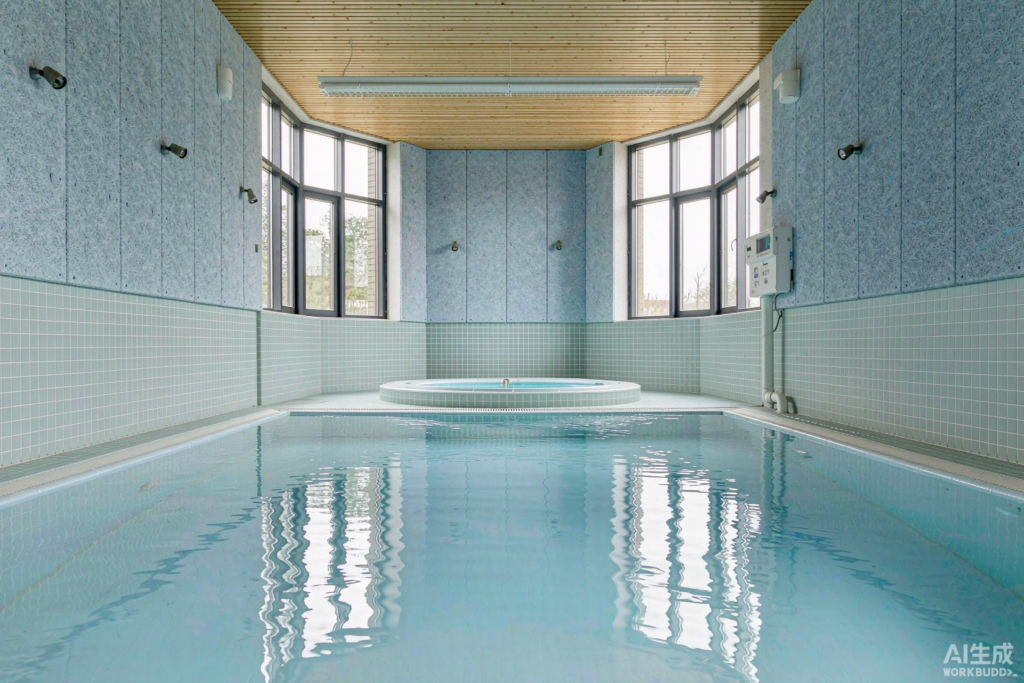
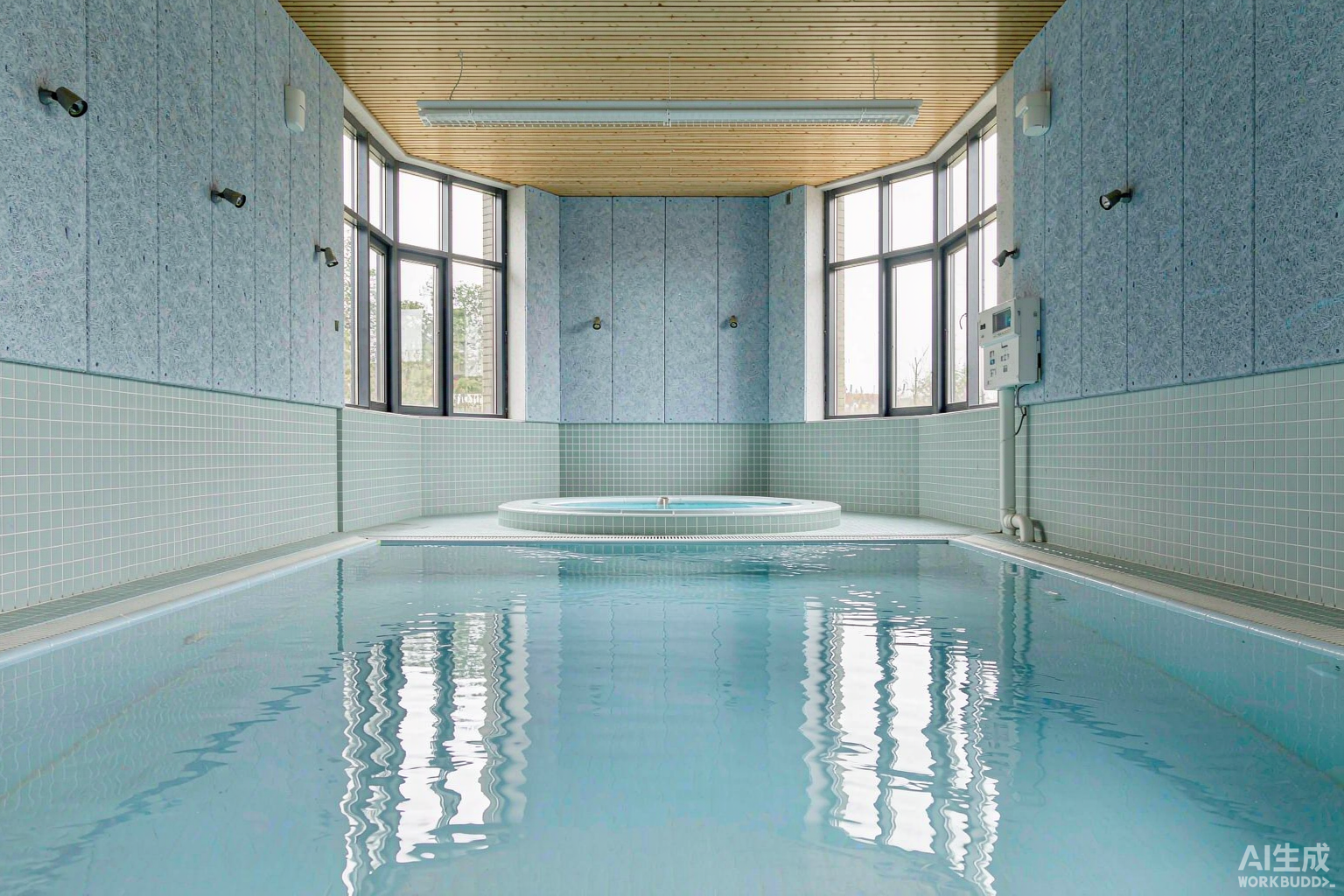
Swimming pools are the most demanding semi-outdoor environment in common construction: near-saturated humidity, chlorine in the air, warm temperatures, and hard reflective surfaces everywhere. Standard felt panels will absorb moisture and chlorine and degrade within a couple of years; the specification must use sealed, non-absorbent facings over an acoustic core, or mineral-based absorbers with a protective finish. Fixings must be corrosion-resistant, and the panels must be positioned above splash zones and out of the condensation path.
The acoustic payoff in a pool hall is large, because reverberation times in untreated pools routinely exceed three seconds and make instruction, safety announcements, and conversation difficult. Treated correctly, a pool hall becomes a usable space rather than an echoing box — which is why operators accept the higher material cost when the alternative is a facility that nobody enjoys using.
Specification checklist for exposed applications
Six items belong in any outdoor or semi-outdoor specification: the exposure category (fully exposed, covered, or interior-adjacent), the material and finish appropriate to that exposure, UV stability data or a service-life statement, the fixing system including corrosion class and movement allowance, the drainage and ventilation path behind the panels, and a maintenance regime that includes periodic inspection of fixings. A supplier who cannot answer all six is selling an interior product into an exterior application, and the failure will appear in year two, not year one.
The commercial view is that exposed work is a small but high-margin segment, because the technical barrier keeps casual competitors out. Suppliers who invest in the detailing knowledge — and who can show installed projects that have survived several seasons — find that clients pay for certainty rather than for square metres.
Maintenance and inspection outdoors
Exterior installations need an inspection regime that interior work does not, and it should be written into the handover. Twice a year, check fixings for corrosion and tightness, since thermal cycling loosens what corrosion has weakened; check edges and joints for water ingress; check for biological growth in damp corners, particularly on north-facing surfaces; and check colour against an archived sample to catch drift early. The inspection takes an hour for a typical terrace installation and prevents the failures that appear in year three.
Cleaning outdoors is simpler than indoors in one respect and harder in another. Rain does much of the work, so dust is rarely the problem; but atmospheric pollution, pollen, and bird droppings are, and they need gentle removal rather than the pressure washing that seems obvious and is exactly wrong. A soft brush and a mild detergent, followed by a rinse, is the correct method for felt; for timber, a brush and a timber-safe cleaner, with any re-oiling done on the manufacturer’s schedule.
Designing for maintenance is part of designing for weather. Panels that can be removed individually for cleaning behind them, fixings that are accessible without dismantling the wall, and a drainage path that does not require removing panels to clear — these details determine whether an exterior installation is maintainable or merely installed.
Finally, be honest about service life. An interior acoustic panel may last twenty years; the same panel outdoors in a demanding climate may give five to eight before replacement is warranted. Clients accept that when it is stated, and resent it when it is discovered. A specification that names an expected service life and a replacement strategy is more professional than one that implies permanence and delivers decay.
Key Takeaways
- UV, moisture cycling, chlorine or salt, and thermal movement do the damage; “water resistant” is not “outdoor”.
- PET felt works in covered semi-outdoor conditions with high density, UV-stabilised pigment, sealed edges and mechanical fixings that allow movement.
- Pool halls need sealed, non-absorbent facings or mineral absorbers — standard felt will fail within a couple of seasons.
- Detail for drainage and wind loading, not just weight: a baffle field outdoors acts as a sail.
- State an expected service life and a replacement strategy rather than implying permanence.
Exposed work is technically demanding and commercially attractive for exactly that reason: the barrier to entry is knowledge rather than capital, and clients pay for certainty when the alternative is a facade that looks tired after two winters.