
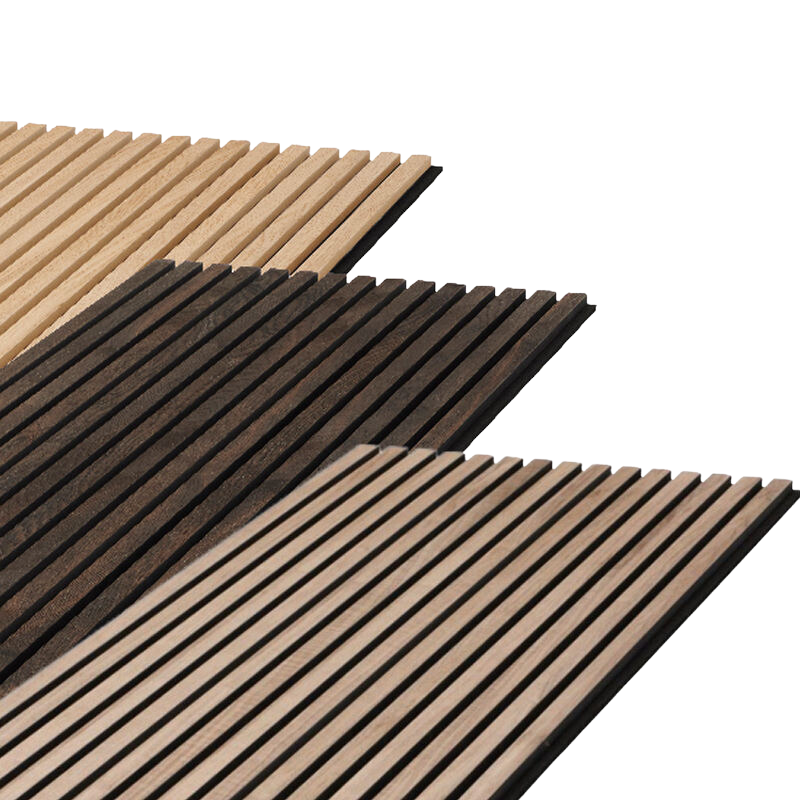
Wood slat acoustic panels have become the default feature wall of the last five years, and the market now contains products at wildly different price points that look the same in a photograph. The difference is construction: what sits behind the slats, how the panel is fixed, and whether the assembly absorbs sound or merely decorates the wall. Buyers who compare on price per square metre without comparing construction are effectively buying a finish, not an acoustic product.
The three constructions on the market
The first is slats on a PET felt backing. The felt layer provides absorption, the slats provide the visual rhythm, and the gaps between slats allow sound to reach the absorber. This is the construction that delivers genuine acoustic performance, and it is also the heaviest per square metre of the three. It is available with different felt thicknesses, and the felt thickness largely determines the absorption curve.
The second is slats on a hollow core or batten frame. The panel is lighter, cheaper to ship, and can be made in larger formats, but the cavity behind may or may not be absorptive depending on whether mineral wool or felt is inserted. Without an absorptive fill, a hollow-core slat panel behaves largely as a diffusive and reflective surface: it breaks up some high-frequency reflection but does not reduce reverberation meaningfully. It is a legitimate product for decorative use and an expensive mistake where acoustic control is the goal.
The third is slats bonded directly to MDF or plywood. This is a decorative panel in the fullest sense: solid, heavy, and acoustically reflective. It has its place in joinery-led interiors where the wall is meant to be solid, but it should never be specified against a reverberation target.
How absorption actually happens in a slat panel
A slat panel is a Helmholtz-like system. Sound passes through the gaps between slats, reaches the absorber behind, and is converted to heat; the slat width, gap width, and cavity depth together determine which frequencies pass most efficiently. Opening the slat ratio — narrower slats with wider gaps — increases absorption at the cost of visual density. Closing it does the opposite. That trade-off is a design decision, and it should be made with the acoustic target in mind rather than by choosing the pattern that photographs best.
The practical implication is that two slat panels with identical felt backing but different slat geometry will not have identical absorption. Suppliers who publish data for their standard geometry are being helpful; suppliers who publish a single figure for a whole family are compressing a range of outcomes into one number. Ask for the data for the exact geometry being ordered.
Weight, fixing and structural consequences
Felt-backed slat panels are heavy. A 2.4 metre by 0.6 metre panel with a 12 mm felt backing and 12 mm slats can weigh substantially more than a hollow-core alternative, and that weight determines the fixing method, the substrate requirements, and the number of installers needed. It also affects freight: heavier panels mean fewer square metres per container, which is a real cost difference that does not appear in the per-square-metre price.
On site, weight shows up as a programme issue. Heavy panels require two installers and mechanical lifting for high walls; hollow-core panels can be handled by one. For a large feature wall in a busy fit-out, that difference can decide whether the acoustic package delays the handover. Specifying weight per square metre alongside the panel format lets the contractor plan lifting and labour accurately.
Fire performance differs by construction
Slat panels combine combustible and non-combustible elements differently depending on construction. A felt-backed panel’s reaction to fire depends on the felt, the timber slats, and the adhesive between them, tested as an assembly. A hollow-core panel with a mineral fill may achieve a different classification. Buyers should require the classification of the complete panel as supplied, tested to the standard the project requires, and should not accept a classification for the felt alone or for the timber alone.
This is where cheap products most often fail scrutiny, because testing an assembly costs money and marketing a material does not. A supplier who can produce an assembly test report — not a material data sheet — is a supplier who has invested in the product rather than in the brochure.
Choosing the right construction
Three decision rules cover most briefs. If the wall must contribute to a reverberation target, specify felt-backed with a stated felt thickness and published absorption data for the slat geometry. If the wall is decorative and the room is already treated, a hollow-core panel is a legitimate and economical choice, provided the fire classification is appropriate. If the wall must be solid, impact-resistant, or part of a joinery package, slats on board are appropriate — with the understanding that acoustic benefit will come from elsewhere in the room.
The final point is about honesty in specification. A slat wall is one of the few acoustic products where appearance, performance, and price can be traded against each other almost independently. That makes it easy to buy the wrong one and hard to notice until the space is occupied and the echo is still there. Naming the construction, the felt thickness, and the slat geometry in the specification is what prevents that outcome.
The acoustic numbers, and how to read a slat panel datasheet
Slat panel datasheets vary in quality, and the differences usually reveal the construction. A well-documented product states the slat width, the gap width, the felt thickness and density, the mounting condition, and absorption coefficients in octave bands from 125 Hz to 4 kHz. A poorly documented one gives a single NRC figure with no conditions attached.
Two patterns are worth knowing. First, slat panels typically show a dip in absorption around 250 to 500 Hz where the slat-gap resonance sits, recovering above 1 kHz. That dip is why a slat wall alone rarely solves a speech-range problem in a hard room, and why combining slats with a separate absorptive element — a felt ceiling, baffles, or plain felt panels — usually outperforms a full wall of slats. Second, opening the slat ratio (wider gaps) flattens the curve and raises overall absorption, at the cost of visual density, which is a design lever that should be used deliberately.
The third point is about the cavity. A slat panel on a battened cavity behaves as a different absorber from the same panel direct-fixed, and the difference is largest in the low bands. Where a datasheet offers both conditions, read the one that matches the installation; where it offers neither, ask.
For specification writers, the practical sentence is: state slat width, gap width, felt thickness and density, mounting condition, and the absorption coefficients you expect to achieve — then require a test report for that configuration. A supplier who can meet that sentence is a supplier who has tested the product rather than the concept, which is the distinction that decides whether a beautiful wall also performs.