
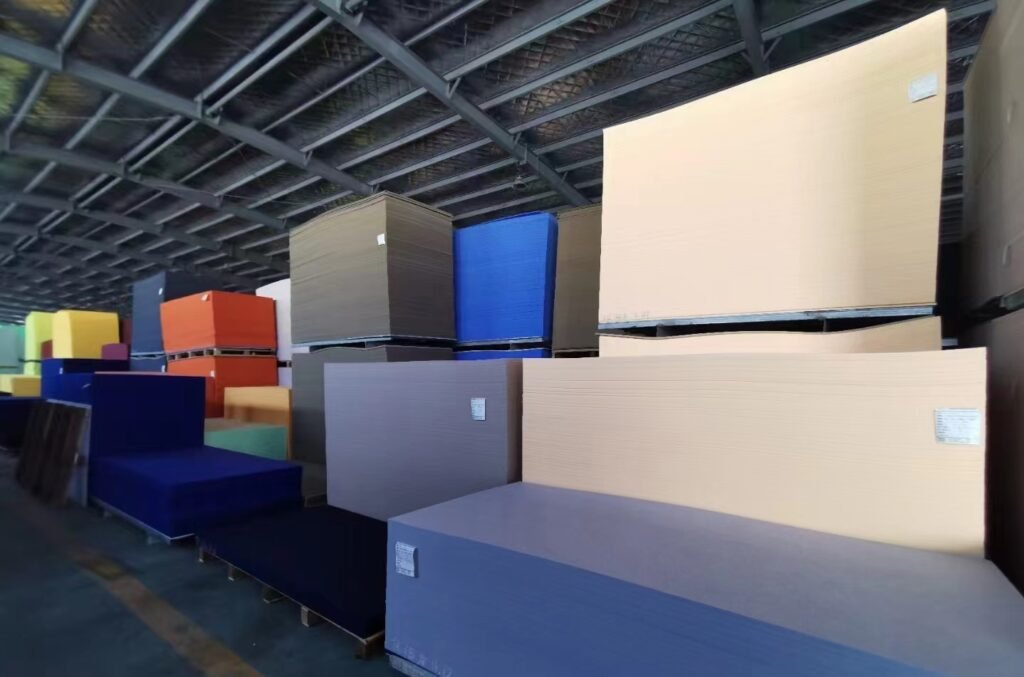
Two panels, both 12 mm, both described as PET acoustic felt, both quoting an NRC of 0.80. One performs, one disappoints. The difference is almost always density, and it is the specification variable buyers most often leave unstated. Understanding how density and thickness interact is the difference between specifying a panel that works and specifying a number that happened to appear in a brochure.
What density actually does
PET felt is a non-woven of bonded polyester fibres. Density describes how much fibre mass occupies a given volume, and it governs two things simultaneously: how much sound energy the material can convert into heat as it passes through the fibre matrix, and how structurally rigid the panel is. Low-density felt — around 1,200 to 1,500 grams per square metre at 9 mm — is soft, drapes, and absorbs well in the mid and high bands but contributes little below 250 Hz and requires a solid substrate if it is to stay flat. High-density felt — 2,000 grams per square metre and above at 12 mm — is rigid enough to be self-supporting, absorbs more broadly, and resists impact.
The commercial consequence is that density is where manufacturers hide cost. A panel can be made to the same nominal thickness at a lower density and still look identical in a photograph; the absorption data, however, is not identical. Buyers who specify only thickness are comparing the surface of the product rather than the product.

How thickness shifts the absorption curve
Thickness controls the frequency at which absorption becomes effective. A thin panel absorbs primarily above 500 Hz; doubling the thickness typically extends useful absorption down toward 250 Hz; and to gain meaningful performance below 125 Hz requires depth measured in tens of millimetres plus a cavity, not a thicker panel alone. That relationship explains why a 9 mm panel is adequate for speech-range control in an office while a 24 mm panel is required in a room with music, machinery, or low-frequency complaint.
The practical matrix most projects need has four rows. For general office and classroom walls where the goal is speech-range control, 9 mm at standard density is sufficient and economical. For corridors, meeting rooms, and spaces where a more balanced absorption curve is wanted, 12 mm at medium-high density is the workhorse specification. For hospitality, music rooms, and spaces with noticeable low-frequency content, 24 mm at high density, ideally on a cavity, is the appropriate choice. For gyms, sports halls, and impact-exposed areas, 24 mm at high density serves both acoustic and durability purposes, and thinner products should not be proposed.
Mounting changes everything
Absorption data is only meaningful with its mounting condition attached. The same 12 mm panel tested direct-fixed and tested on a 50 mm cavity produces two different curves, with the cavity version extending performance lower in frequency. Specification documents that quote a single figure without naming the mounting condition are, strictly speaking, incomplete — and the gap between the two conditions is large enough to explain a failed project.
Buyers should insist on three pieces of information for any panel under consideration: density in grams per square metre, thickness in millimetres, and the mounting condition under which the absorption data was measured. With those three, competing products can be compared honestly. Without them, the comparison is between marketing claims.
Structural and handling implications
Density also determines what the panel can be used for. Self-supporting panels can span between fixings, form freestanding screens, and be cut into shapes without a backing; low-density panels cannot. Weight per square metre rises with density, which matters for ceiling systems, for adhesive fixing, and for transport cost — a high-density 24 mm panel can weigh several times what a 9 mm low-density panel does per square metre, and a ceiling grid must be rated for it.
The procurement implication is that density should be specified together with the application, not independently. A project that specifies “PET felt, 2,000 gsm, 12 mm” for a wall application has specified a product; a project that specifies only “12 mm PET felt” has specified an appearance and left the performance to the supplier’s margin.
A specification checklist
Five items close the gap: nominal thickness with tolerance; density in grams per square metre; absorption coefficients by octave band, with the mounting condition stated; fire classification for the finished panel, tested as supplied; and recycled content with verification. A quotation that answers all five, and a sample that matches the density claimed, is a quotation that can be compared. Everything else is a conversation about colour, which is important but rarely the reason a room sounds wrong.
How to test a sample before you commit to a container
Buyers who cannot run laboratory tests can still assess density and quality with three simple checks on a sample. The first is weight: a 300 by 300 mm sample of 12 mm felt at around 2,000 grams per square metre weighs roughly 216 grams, and a kitchen scale will tell you whether the delivered product matches the claim. The second is edge quality: cut a sample with a sharp blade and look at the cut face — a dense, well-bonded felt cuts cleanly, while a low-density or poorly bonded product shows loose fibres and a ragged edge.
The third is recovery: compress the sample firmly between thumb and forefinger and release it. A good felt returns almost completely; a poor one retains a visible depression. This matters more than it sounds, because recovery under compression is exactly what determines whether a panel behind a chair or a door handle looks new after two years.
For projects where performance is contractually specified, the sample check should be backed by documentation: the density and thickness on the delivery note, matched against the specification, and a retained sample kept on site for comparison during installation. Disputes about whether the delivered panels match the approved sample are far easier to resolve when the approved sample exists in a sealed bag with a date on it.
Finally, test the whole assembly rather than the panel alone. A dense panel on a poor substrate, fixed with three dabs of adhesive, behaves worse than a moderate panel correctly fixed. Buyers who validate the fixing method as carefully as the panel avoid the most common cause of a wall that measures correctly in a lab and fails in a room.
Key Takeaways
- Density determines both absorption and rigidity, and it is invisible in a photograph; thickness controls which frequency band the panel works in.
- Specify three things together: grams per square metre, thickness in millimetres, and the mounting condition used for the absorption data.
- Four rows cover most projects: 9 mm for speech-range walls, 12 mm as the workhorse, 24 mm for music and low-frequency content, 24 mm high-density for impact zones.
- A kitchen scale, a sharp blade and a thumb test will tell you more about a sample than a datasheet will.
- Retain a sealed, dated sample on site so that a delivery dispute has a reference rather than an argument.
What makes this practical is that the buyer controls it entirely. No laboratory is needed to check a delivery against a specification, and no negotiation is needed to ask for the three numbers that make comparison possible. The only requirement is to ask before the order rather than after the complaint.