
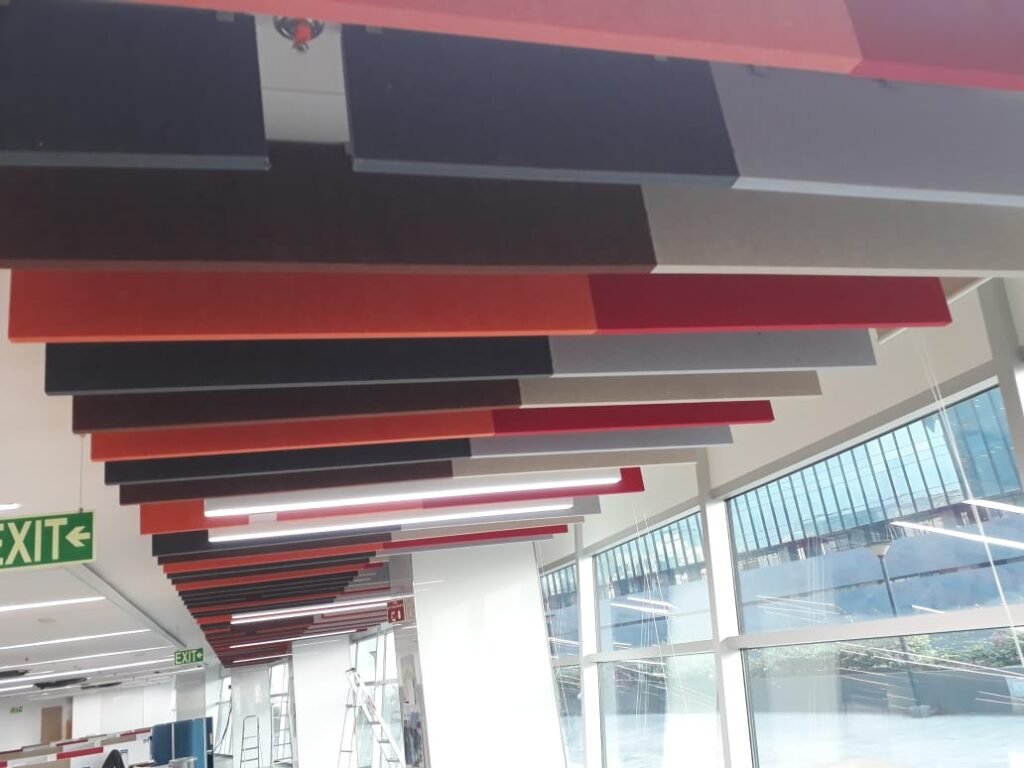
A European consultant asking for “the DoP” is not being difficult; they are following a legal framework that has been in force since 2013 and that places obligations on everyone in the supply chain, including the importer. For acoustic panel suppliers outside the EU, this is where deals stall: the product performs, the price is competitive, and the project cannot proceed because the paperwork does not exist in the right form. Understanding the framework removes that stall.
What CE marking actually means for a panel
CE marking is not a quality award and not a certification of acoustic excellence. It is a declaration that the product has been assessed against a harmonised standard and that its performance is declared consistently. For suspended ceilings and ceiling kits, the relevant harmonised standard is EN 13964; wall panels that are part of a ceiling kit or a defined system may fall within its scope, while free-standing wall absorbers are often covered by other routes or by national requirements. The first practical question for any supplier is therefore scope: which harmonised standard applies to this specific product, in this specific installation?
The answer determines the test programme. EN 13964 requires declaration of reaction to fire, load-bearing capacity, and — where claimed — acoustic absorption, among other characteristics. If a supplier declares sound absorption, that declaration must be backed by testing to the appropriate standard under the appropriate mounting condition. This is the point where informal claims and formal declarations diverge: a marketing figure of “NRC 0.85” means nothing in a DoP unless it is expressed in the units and test conditions the standard requires.
The Declaration of Performance
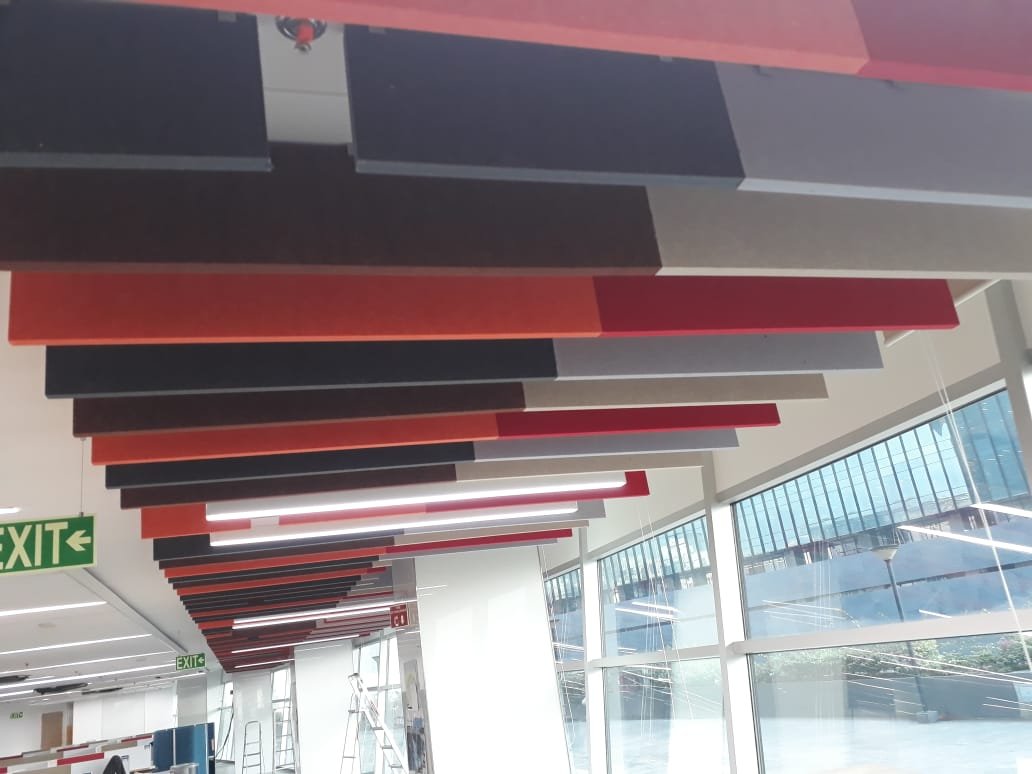
The DoP is the document that carries the declared values, identified by product type, intended use, and the specific characteristics assessed. It has a prescribed structure, must be traceable to a factory production control system, and must accompany the product. For a distributor, the practical checks are straightforward: does the DoP reference the same product and thickness being supplied, does it cover the characteristics the project requires, and is it current? A DoP for a 12 mm panel does not cover a 24 mm panel of the same family, and consultants increasingly check exactly that.
Factory production control is the part overseas suppliers most often underestimate. CE marking assumes an ongoing system — documented procedures, testing frequency, records — not a one-off test report. A supplier who tested once and never maintained the system can produce a certificate but not a defensible DoP. Buyers auditing a new supplier should ask how often production is re-tested against the declared values and who audits the factory; the answers separate suppliers with a system from suppliers with a document.
Where the documentation gaps usually appear
Three gaps recur in real projects. The first is assembly coverage: the DoP is valid for the panel as supplied, while the project specifies a complete system with a specific grid, hanger, and perimeter trim. Where the acoustic or fire performance depends on the assembly, the documentation must cover the assembly, or the specification must be written to accept the panel-level declaration.
The second is language and format. A DoP must be supplied in the language of the member state of use, and a scanned PDF with handwritten annotations will be rejected by a diligent consultant. Suppliers who maintain template DoPs in the main European languages remove a recurring delay at zero cost.
The third is version control. Standards get revised, test reports expire conceptually if not formally, and a project specified in 2025 may be built in 2027. Documentation with a clear revision history is worth more than a thicker folder, because the consultant’s job is to verify currency, not volume.
How this changes supplier selection
For EU-facing distributors, compliance capability is now a selection criterion as important as price. A supplier who can issue a correct DoP for each thickness, in the right language, with a maintained factory production control system, removes weeks from the submittal cycle and protects the distributor from liability as the importer placing the product on the market. That liability is not theoretical: under the Construction Products Regulation, the importer carries obligations that cannot be delegated back to a factory in another jurisdiction with a shrug.
The practical recommendation is to build a compliance pack as a standing asset rather than a project response: the DoP per product family and thickness, the underlying test reports, the factory production control summary, the CE marking artwork for labels and packaging, and a short cover note explaining scope. Distributors who hold that pack report that European tenders stop being a documentation exercise and become a commercial one — which is, after all, where their margin comes from.
The wider point
Compliance is often framed as a barrier to trade. In practice it is a filter that rewards the organised. Panels that meet the same physical performance but arrive with incomplete declarations lose not because they are worse, but because the project cannot legally accept them. Suppliers who invest in the system — testing to the right standard, maintaining production control, issuing declarations correctly and in the right language — find that the investment pays back on every EU project they win while competitors are still assembling paperwork.
A submittal pack that passes first time
Distributors who submit documentation repeatedly learn that consultants reject packs for structural reasons rather than technical ones: the wrong document for the product, a certificate that does not cover the assembly, a missing translation, or a test report without the page that states the mounting condition. A standard submittal pack assembled once eliminates these failures.
The pack should contain, in order: a one-page product summary identifying the exact product, thickness, and finish supplied; the Declaration of Performance for that product, in the project’s language; the underlying test reports with the relevant pages flagged, particularly the mounting condition for absorption and the specimen description for fire; the factory production control summary; and the CE marking artwork as it appears on the label and packaging. Add a short index page and the consultant can verify compliance in minutes rather than working through a folder.
Two practical disciplines keep the pack current. First, version control: every document carries a revision date, and superseded versions are removed rather than left in the folder, because a diligent reviewer who finds two versions will query both. Second, product mapping: a simple table that lists each product family against its documents, so a distributor’s sales team picks the right files without interpretation.
Where a project requires performance beyond the declared values — a specific fire class for a particular assembly, for example — the answer is not to stretch the existing DoP but to obtain a test for that assembly. Suppliers who can arrange this, even at cost, convert a lost specification into a won one; buyers should ask early, because test slots are booked weeks ahead and the project programme rarely accommodates a late request.
Key Takeaways
- CE marking is a declaration against a harmonised standard, not a quality award; EN 13964 governs suspended ceiling kits and related systems.
- A DoP is product- and thickness-specific. A declaration for 12 mm does not cover 24 mm, and consultants increasingly check exactly that.
- Factory production control is the part overseas suppliers underestimate: one test creates a certificate, not a defensible declaration.
- Build a standing compliance pack instead of assembling documents per project — it removes weeks from every EU submittal.
- Where a project needs performance beyond the declared values, obtain a test for that assembly rather than stretching the existing declaration.
The commercial reading is simple: in the EU, a technically excellent panel with incomplete paperwork is an unusable product, and a technically ordinary panel with complete paperwork is a sellable one. That asymmetry rewards organisation over invention, and it rewards it on every project rather than once.