
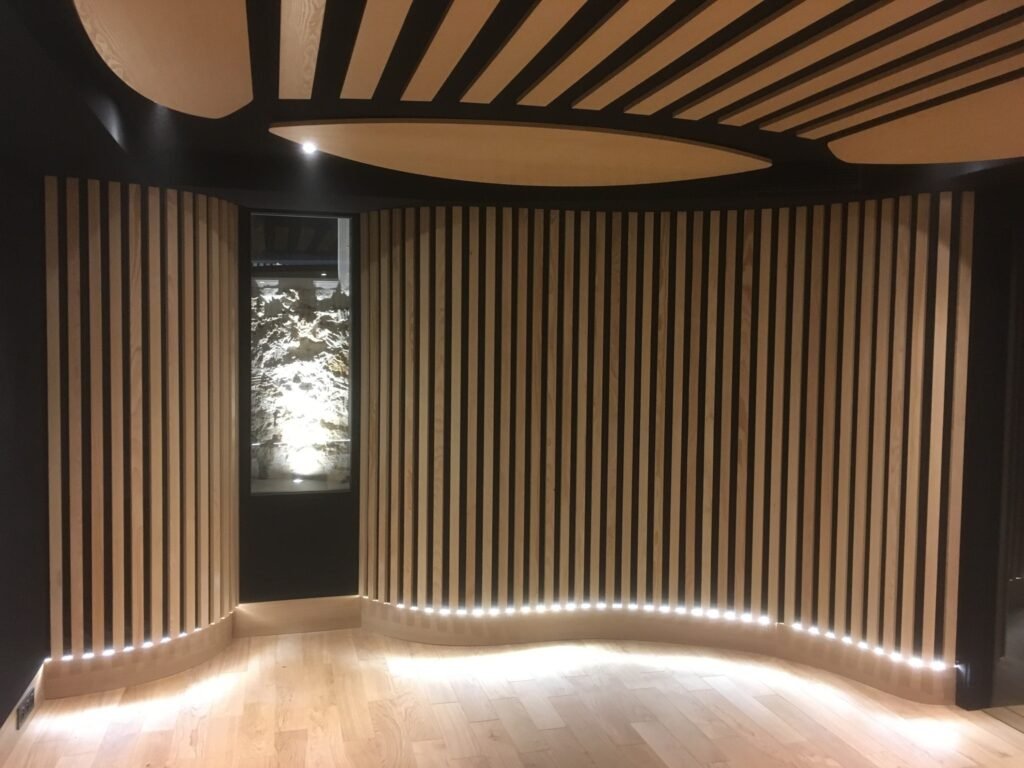
Here is a paradox every acoustic designer meets eventually: you can absorb too much. A room treated wall-to-wall with thick absorbers becomes acoustically dead — conversations feel close and airless, music loses its bloom, and spaces measure “fine” while feeling wrong. The professional answer is not more absorption but a balance of absorption and diffusion — surfaces that remove energy working alongside surfaces that scatter it. Understanding that balance turns panel suppliers into room designers, and commodity orders into considered specifications.
Two ways to tame a reflection
When sound strikes a wall, three things can happen: it reflects (hard surfaces), it absorbs (porous panels converting energy to heat), or it diffuses (irregular surfaces scattering reflection into many weak directions). Each tool serves a different perception:
- Absorption shortens reverberation and removes reflections — clarity, privacy, calm. Overdone, it flattens spaciousness and makes rooms feel dry and small.
- Diffusion preserves liveliness while eliminating harsh reflections — the listener hears a blend instead of a slap. It keeps rooms feeling open even at low reverberation times.
The classic failure modes sit at both extremes: the glass-and-stone lobby that slaps and rings (all reflection), and the over-treated studio-look office that feels like a padded cell (all absorption). Great rooms — concert halls, premium restaurants, high-end home cinemas — mix all three behaviors deliberately.
Where diffusion comes from in panel catalogs
Diffusion does not require exotic devices — several catalog products carry it naturally:
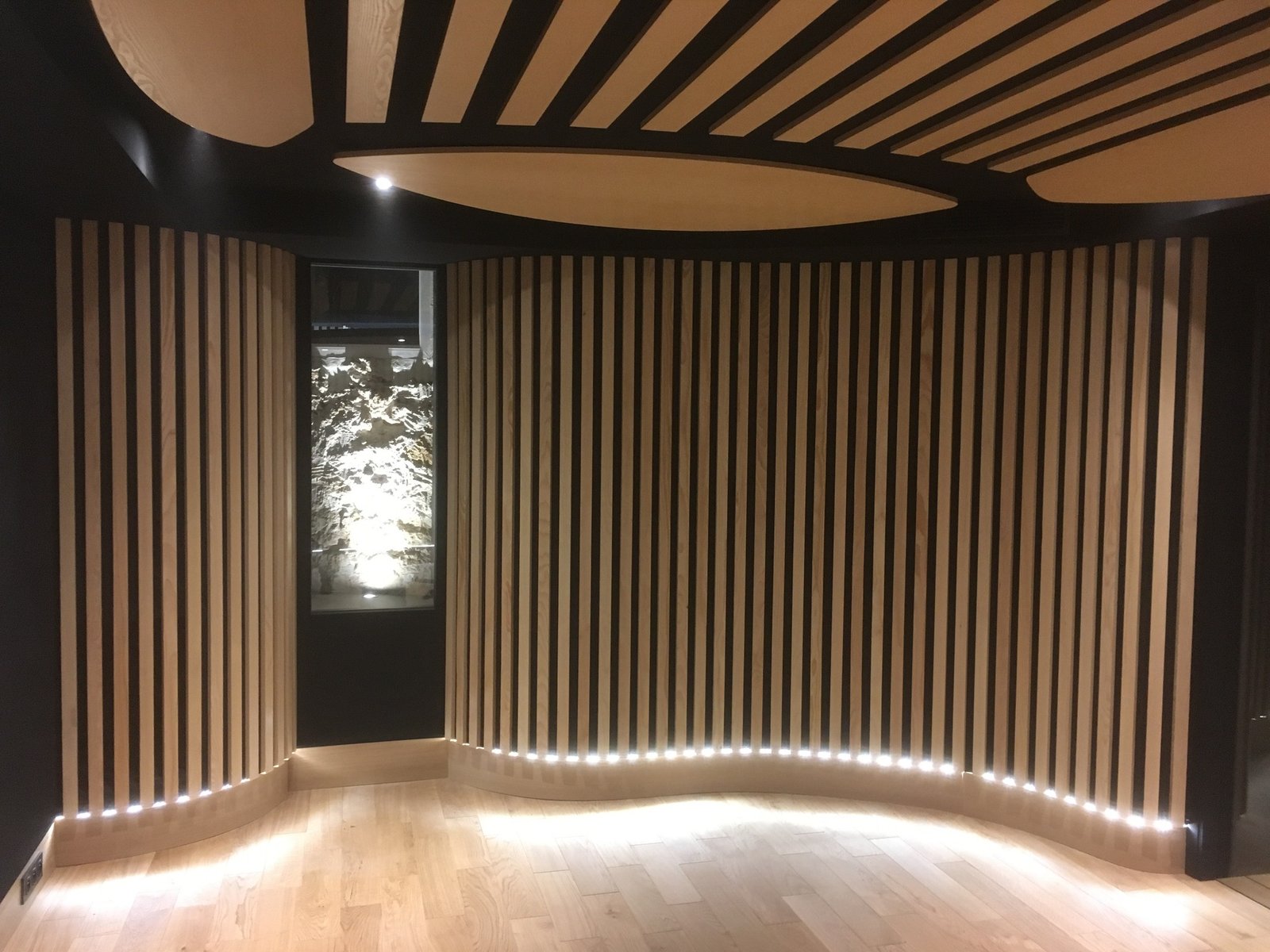
- Wood slat panels. The gaps and slat rhythm scatter mid and high frequencies while the PET backing absorbs — a genuine hybrid product, which is exactly why they dominate premium interiors.
- Profiled and fluted wood panels. Grooved and corrugated surfaces add controlled scattering on walls that must stay hard-ish, common in lobbies and circulation zones.
- QRD-style diffusers. Sequenced-depth elements (quadratic residue diffusers) engineered for phase-scattered reflection — the specialist tool for studios and listening rooms.
- Geometric PET panels. 3D-cut felt blocks combine absorption with edge-scattering; the pyramids and waves of the design catalog do real acoustic work.

A practical mixing recipe
Balanced rooms follow a loose allocation logic rather than a formula:
- Absorb where speech lives. First-reflection points, ceilings over talk zones, rear walls of meeting rooms: porous panels (PET felt, 12–24mm, cavity where possible).
- Diffuse where life is wanted. Side walls of music and hospitality spaces, rear walls of larger rooms, any surface where a mirror-like reflection would slap.
- Reflect deliberately. Sometimes a hard surface is the feature — a statement stone wall softened by nearby absorption instead of treatment on itself.
- Avoid symmetric over-treatment. Distribute absorption and diffusion asymmetrically; perfectly mirrored treatment creates its own coloration.
Selling the concept
For suppliers, the absorption-diffusion conversation is an upsell with integrity. The customer who asked for “panels everywhere” gets a better room and a smaller absorber bill; the distributor gains the reputation of someone who designs rooms, not just ships boxes. The pitch fits in one sentence: absorption controls the sound, diffusion keeps the room alive — slat panels and felt together give you both from one supplier. Rooms built on that balance are the ones clients bring visitors to see — and the ones that specify your name on the next project.
Reading a Room: Where Absorption Ends and Diffusion Begins
The starting point is a walk-through with fresh ears. Clap once in the empty room and listen to what returns: a fast metallic ring points to parallel hard surfaces needing absorption or diffusion; a slow boom points to low-frequency buildup needing thick absorption in corners; speech that stays intelligible suggests the room mainly needs first-reflection control. Walk the walls and note where the early reflections arrive – the mirror trick works literally: sit in the listening or speaking position while a colleague slides a mirror along the wall; wherever you can see the sound source in the mirror is a first-reflection point, and those points earn absorption first. Everything beyond the first reflections is where diffusion does its sculpting.
Budget allocation follows the same logic. First-reflection absorption – typically panels of 24 mm felt or thicker at ear height – delivers the largest audible improvement per square metre and should claim the priority share of any budget. Rear-wall treatment comes next, where absorption prevents slap-back echo in deeper rooms, or diffusion where the design wants the back of the room to feel alive rather than dead. Ceiling treatment completes the framework in reverberant spaces. Diffusers spread through the remaining budget bring spatial quality: a room with 70 percent absorption and 30 percent diffusion at strategic points sounds finished in a way that a fully absorptive room never does.
Practical Combinations That Work
Certain pairings recur in successful rooms because they solve complementary problems. Meeting rooms combine rear-wall diffusion with side-wall absorption: speech stays intimate at the table while the room avoids the over-damped hush that makes calls sound lifeless. Music and media rooms combine thick corner absorption with broad-area diffusion, controlling bass while preserving envelopment. Offices pair ceiling absorption with diffusive wall elements behind collaboration zones, keeping energy in group discussion without letting it smear across the floor plate. In each case the diffuser does a job absorption cannot: it scatters energy in time and space, keeping the room’s sense of size and life while absorption removes the glare. Specifiers who communicate this distinction to clients – absorption as the cleanup, diffusion as the seasoning – set expectations that the finished room can actually meet, and the difference is audible to everyone who uses the space.
Key Takeaways
- First-reflection points earn absorption first – find them with the mirror trick.
- A 70/30 absorption-to-diffusion balance sounds finished; full absorption sounds dead.
- Rear-wall diffusion prevents slap-back while keeping rooms alive.
- Explain absorption as cleanup and diffusion as seasoning – expectations the finished room can meet.
One practical warning completes the guidance: resist the temptation to solve everything with absorption, because the failure mode is real and expensive to reverse. Over-absorbed rooms feel acoustically dead, suppress conversation, and make speech through a video call sound worse, not better – the room loses the reflections that give voices presence. The symptom is easy to recognise once heard: people unconsciously speak louder, meetings feel effortful, and occupants describe the space as somehow uncomfortable without being able to say why. Diffusion is the antidote, and the balance point is project-specific, which is why a measured target and a post-installation check matter as much in design-led rooms as in code-driven ones. Rooms that hit the balance are the ones clients bring visitors to see – which is, quietly, the strongest reference a distributor can own.