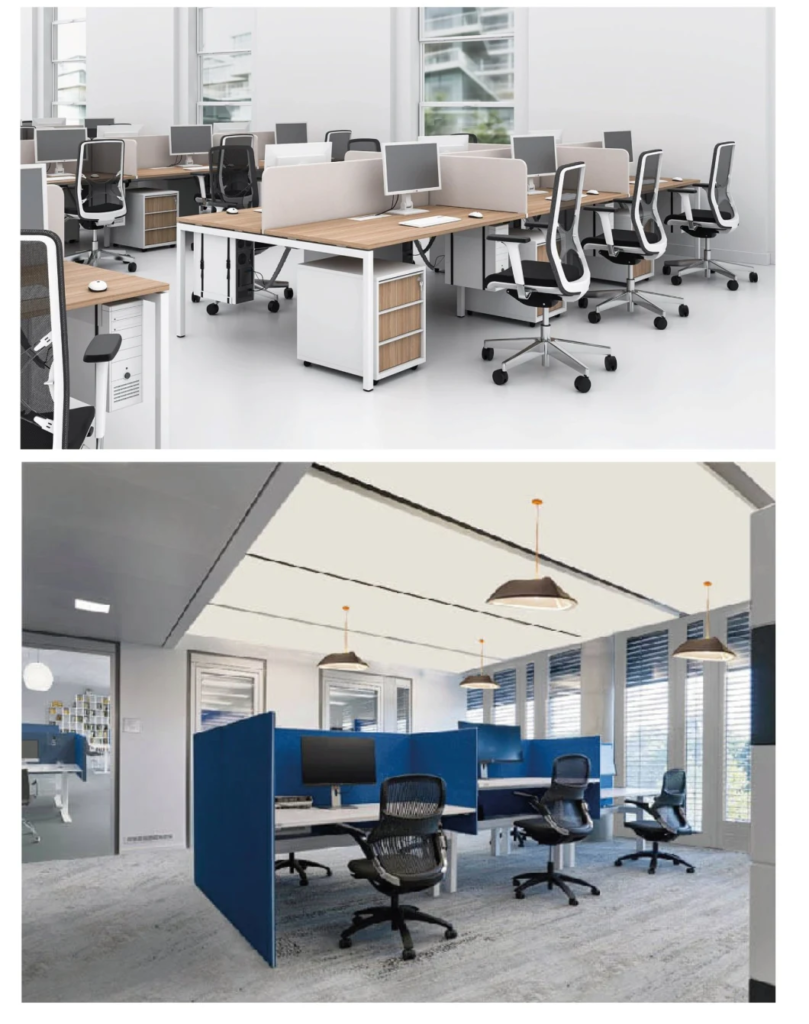
Open-plan offices promised flexibility and delivered — along with a noise problem. The industry’s first response was construction: more rooms, more glass, more ceiling treatment. The most economical response, though, works at the scale where the noise actually lives: the desk. Acoustic dividers and desk screens — freestanding or clamped PET felt panels placed directly into the speech path — deliver measurable absorption, visual privacy and total flexibility for a fraction of built solutions. For distributors, they are also the perfect entry product: affordable, colorful, and easy to sell in dozens.
Why screens work: the physics of proximity
Sound absorption obeys the same rule as real estate: location, location, location. A screen standing between two talkers intercepts the direct speech path — the strongest, most intelligible component of the noise — before it spreads. Because the panel sits at mouth height where speech energy is concentrated, even a modest screen area does work that would take many square meters of wall treatment to match. Add the absorptive faces on both sides and the screen also shortens reverberation locally, softening the entire desk cluster around it.

The format landscape
The category has matured into distinct families, each answering a different workspace pattern:
- Clamp-on desk screens. Steel or aluminum clamps grip the desk edge; no tools beyond a hex key. The volume product — retrofittable in minutes, popular with coworking chains and corporate refresh cycles.
- Freestanding divider panels. Larger panels on stable feet, defining zones without touching the furniture. Ideal for agile layouts where desks move weekly.
- Hanging partitions. Suspended from the slab, they divide space from above — often with CNC-cut silhouettes or printed graphics that double as wayfinding and branding.
- Mobile screens on casters. Absorption that follows the team: training rooms, project pods, event spaces.
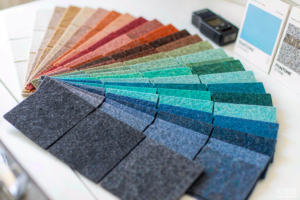
Across all formats, PET felt is the default core: lightweight, rigid, tackable (notes pin directly into it), and available in colors that turn office zoning into brand expression. Edge detailing — aluminum trim, contrasting fabric edging — separates premium SKUs from basics.

What buyers should evaluate
- Stability and fixings. A screen that wobbles gets removed. Check clamp range against actual desk thicknesses and foot geometry against cleaning robots and vacuum lines.
- Height and coverage. Effective speech interception starts around 400mm above the desk surface; taller is better for privacy, lower preserves sightlines and daylight. Match to the office’s culture, not just the catalog.
- Material credentials. Formaldehyde-free PET with fire documentation (EN 13501-1 or ASTM E84) is increasingly a corporate procurement requirement, not a nice-to-have.
- Cleanability. Felt surfaces in hot-desk environments need vacuum-friendly, anti-static properties; some facilities request wipe-clean face laminates for shared desks.
- Color and customization. Brand palettes, printed logos and two-tone constructions turn screens from furniture into identity — and justify premium pricing.
The channel opportunity
Desk screens occupy a sweet spot in the acoustic market: low commitment, high visibility, repeat purchase. They open doors — a facilities manager who buys 200 screens this year buys wall panels and baffles next year from the supplier who understood the office first. Stock the standard colors, offer custom printing as an upsell, and treat every screen order as the first conversation in a much larger acoustic relationship.
Screen Height, Coverage, and the Physics of Small Barriers
A desk screen is acoustically honest: it blocks what it covers and deflects what rises above it. Direct sound from a neighbouring conversation travels in a line; a 400 to 500 mm screen above the worktop intercepts most of that line for a seated listener, which is why speech clarity improves immediately after installation. Sound that diffracts over the top edge loses energy at the bend, arriving softened rather than silenced. The practical specification guidance: mount screens so the top edge reaches the seated ear height of the user, extend them horizontally past the desk edges by at least 150 mm where possible, and close the gap between desk surface and screen bottom, which is the leak most installations forget.
Material thickness governs how much absorption each screen contributes. Thin fabric-wrapped foam cores do visual duty with modest absorption; 9 to 12 mm PET felt cores deliver meaningful mid-to-high frequency absorption on both faces; and double-sided screens outperform single-faced ones simply by doubling treated area. Because screens sit close to talkers, they absorb at the source – the most efficient position acoustically, and the reason a modest screen programme measurably lowers the overall noise floor of an office floor plate.
From Screens to Zoning: Designing the Whole Floor
Screens work best as one layer in a zoning strategy. Map the floor by loudness intent: collaborative zones, focus areas, phone booths, and social space. Screens define and absorb the collaborative zones; quiet zones get both screens and heavier wall treatment; circulation routes stay untreated so the contrast between zones is legible to occupants. Acoustic partitions – floor-to-ceiling or 1.8 metre freestanding units in thicker felt – then carve focus rooms and breakout areas out of open plan space at a fraction of drywall cost, with the advantage of demountability when layouts change. Facilities teams value that flexibility explicitly: a screen and partition inventory can be reconfigured across three fit-out cycles, absorbing reorganisation costs that fixed construction would impose in full. Offices that combine source-side screens, zone partitions, and ceiling treatment report the compound effect: measured noise floor reductions and, in staff surveys, the difference between an open plan people endure and one that actually works.
Key Takeaways
- Mount screens to seated ear height, extend past desk edges, and close the desk-to-screen gap.
- 9-12 mm double-sided felt cores absorb meaningfully at the source – the most efficient position.
- Zoning beats product counts: map loudness intent, then place screens, partitions, and treatment accordingly.
- Demountable systems serve three fit-out cycles and absorb reorganisation costs.
A brief word on specification quality, because the screen market spans a wide range. Check that the core material and thickness are stated – not just a fabric colour – and that the declared absorption comes from a test, not an illustration. Edges matter in daily use: a finished edge on a felt screen survives cleaning carts and chair backs, while a raw edge frays within months. Fixing hardware should be matched to the actual desk: clamp-on brackets for adjustable desks, through-top fixings for solid worktops, and freestanding feet where desks get reconfigured. None of these details costs much individually; together they separate a screen that still looks specified after three years from one that quietly degrades. Distributors who check these four points before adding a screen line to their catalogue spare themselves the returns.