
Acoustic panels were built for the showroom: touch the felt, hear the difference, stand in the demo room. Yet a growing share of panel purchases now begins — and often completes — on a screen. Distributors who mastered the physical sample library are discovering a second sales floor, and it operates around the clock. The tools are straightforward: a content-rich website, a digital sample system, and augmented-reality previews that let a customer see panels on their own wall before ordering a single sample. Here is how the online channel actually works for a product you cannot hear through a browser.
The website as the first showroom
Most B2B panel journeys now start with a search: “wood slat acoustic panel office”, “PET felt panels colors”, “ceiling baffles for restaurant”. The distributor whose site answers those searches with real content — product data, application galleries, comparison guides — enters the conversation before the competitor with a beautiful catalog PDF. The content that converts is specific: per-thickness absorption data, fire certificates downloadable in one click, high-resolution photography in real interiors, and honest installation guidance. Search engines reward depth; buyers reward clarity; the two reinforce each other.

Digital sampling without the courier bill
Physical samples remain essential — but digital sampling pre-qualifies them. The tools that work:
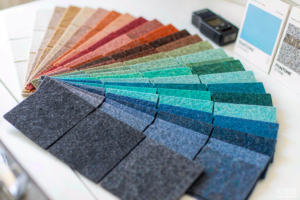
- Color-accurate swatch libraries. Photographed under controlled lighting with a reference card in frame, so customers calibrate their screens and stop guessing at colors.
- Sample kits as a product. A boxed, branded sample set — one per color family — shipped free to qualified buyers converts better than piecemeal swatches and costs less than chasing every request.
- Video, not just photos. Thirty seconds of a panel being touched, cut and installed answers the “how does the felt actually feel” question that stalls many online decisions.
AR: the fitting room for walls
Augmented reality has crossed from gimmick to sales tool for surfaces. A customer with a phone can project a wood slat wall or a felt panel field onto their actual room, switch veneers and colors in seconds, and screenshot the result for their client or spouse. For distributors, AR solves the classic acoustic-sales problem — visualization — and shrinks the decision cycle from weeks of sample ping-pong to a same-evening “we like the walnut”. Manufacturers increasingly supply AR-ready 3D models of their panel families; distributors should treat them like sample kits: available, current, and pushed into every quotation email.

Turning digital interest into container orders
The online channel’s endgame is not a single-panel e-commerce sale — it is the project conversation. Three practices convert web traffic into wholesale relationships:
- Fast, human follow-up. A quotation request answered within one business day with a named contact converts several times better than an auto-reply.
- Content per segment. Restaurant owners, school facility managers and studio builders search differently; dedicated application pages catch each of them.
- Proof at every step. Project galleries, review quotes and certificate downloads remove the risk objections that stall first orders from new buyers.
The hybrid future
The winning model is not digital instead of physical — it is digital feeding physical. The website and AR tool qualify and excite; the sample kit confirms; the quotation and container close. Distributors who build this funnel now will find that their showroom hours extend around the clock, their sampling costs fall, and their panel business gains a compounding asset: a website that sells while they sleep.
What Buyers Actually Do in a Digital Showroom
Analytics from early-adopter distributors reveal a consistent pattern. Buyers rarely browse full catalogues; they arrive with a project type and a colour family, filter to a shortlist within minutes, and then do one of two things: download the technical data sheet, or request a physical sample. The digital showroom’s real job is to make both actions frictionless. Data sheets should sit one click from every product image, and the sample request should remember the shortlist rather than forcing re-selection. Distributors who restructured their showrooms around this two-action model report sample conversion rates rising sharply, because the online experience ends where the physical experience begins instead of competing with it.
Augmented reality earns its place in the same way. The winning implementations are narrow: a phone-camera view that overlays the chosen panel colour and format onto a photo of the customer’s actual wall. Full architectural visualisation belongs to the designer’s software; the AR layer serves the person who needs to see whether that terracotta felt clashes with the existing floor. Vendors report that AR views correlate with higher-intent enquiries, and that the feature pays for itself simply by reducing the colour-mismatch returns that plague distance selling of coloured textiles.
Practical First Steps for an Importer or Distributor
A capable digital presence does not require custom software. Start with three moves. First, publish honest photography: every colour under consistent neutral lighting, with true-to-print files and a disclaimer about screen calibration – this alone removes most colour disputes. Second, build the sample programme into the site: sample boxes with tracked shipping, credited back against first orders above a threshold, which converts browser cost into order commitment. Third, attach the technical layer: absorption data, fire certificates, and installation guides downloadable without a login gate, because the consultant specifying your product at nine in the evening will not register an account to do it. Distributors who complete these three steps typically see their quote-to-order ratio improve within a quarter, and they enter every AR and 3D investment from a foundation that already sells.
Key Takeaways
- Buyers do two things online: download the data sheet and request a sample – make both frictionless.
- Consistent neutral-light photography with a calibration disclaimer removes most colour disputes.
- Credit sample boxes against first orders to convert browsing cost into commitment.
- Publish technical documents without a login gate; consultants specify at nine in the evening.
Measurement closes the argument. Distributors who reorganised their digital presence around the two-action model track a simple funnel: visits, shortlists, data-sheet downloads, sample requests, quotations, orders. The numbers make investment decisions easy, because each stage’s conversion is visible and each improvement is attributable – a faster sample flow shows up within weeks, a better data-sheet layout shows up in consultant enquiries. Compare that with traditional trade spending, where a fair or an advertisement reports only a feeling of presence, and the case for the digital channel becomes self-funding. None of this replaces the relationships that distribution runs on; it feeds them. The showroom sells the first meeting, the sample sells the product, and the relationship sells the next ten years – each stage doing the job it is best at.