
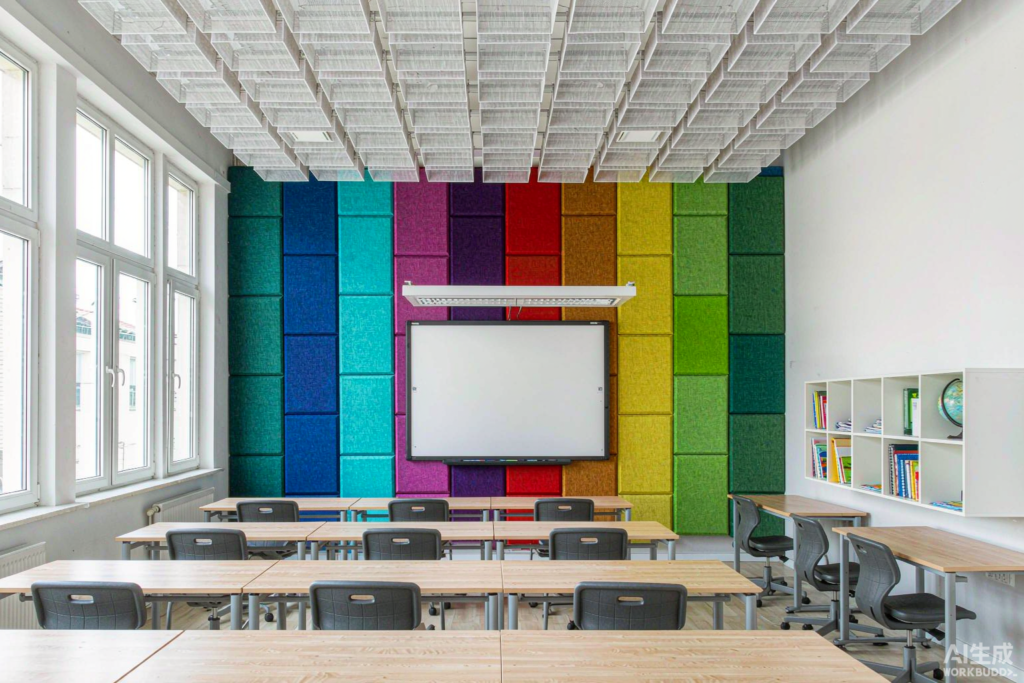
For most of the twentieth century, classroom acoustics were nobody’s legal responsibility. Today they are written into building codes, education standards and green building frameworks across the world — and every new school tender that lands on a distributor’s desk increasingly carries a reverberation target with a number attached. Understanding where these standards come from, what they actually require, and how products satisfy them has become essential knowledge for everyone in the acoustic panel supply chain.
Why classrooms came first
The research case is unusually strong. Studies across dozens of countries converge on the same finding: in reverberant classrooms, speech intelligibility collapses for the listeners least able to compensate — young children, students learning in a second language, and those with hearing impairments. A teacher competing with a 1.2-second reverberant room effectively loses a meaningful share of every lesson to echo. Because the affected population is captive and the remedy is affordable, regulators found school acoustics to be the most defensible place to start writing acoustic requirements into law.
What the major standards actually say
- United States (ANSI S12.60). The benchmark standard sets unoccupied reverberation in core learning spaces at 0.6 seconds (0.7s for larger classrooms), alongside background-noise limits. Many states reference it in their school facility standards.
- United Kingdom (Building Bulletin 93). BB93 specifies reverberation times per room type — around 0.6 seconds for primary classrooms — and has driven acoustic testing into standard school handover documents.
- Europe. National codes vary but converge on 0.5–0.8 seconds for classrooms; ISO 3382-2 provides the measurement methodology that turns a design target into a handover check.
- Asia-Pacific. China, Japan and Australia include classroom acoustic requirements in school construction standards, with enforcement tightening as school infrastructure programs expand.
The unifying pattern: a design-stage target, a measurement at handover, and consequences for missing it. That structure transforms acoustics from an optional extra into a deliverable — with a paper trail that runs straight through the panel supply chain.
How projects actually hit the numbers
Achieving 0.6 seconds in a typical classroom is straightforward when treatment is planned early. The standard recipe combines three elements:
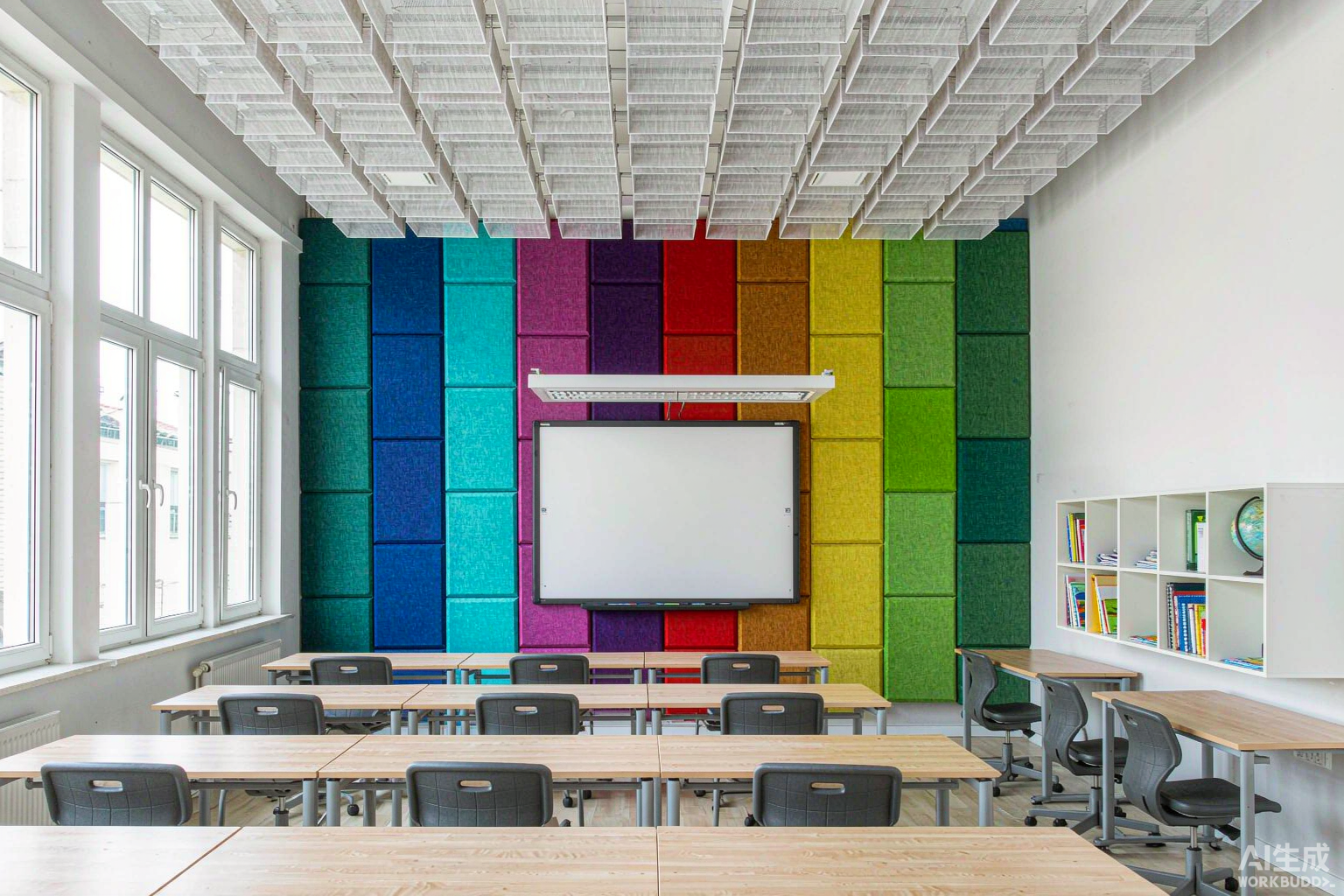
- Rear and side wall absorption. 12mm PET panels above desk height on the surfaces facing the teacher — the reflection paths that do the most damage to intelligibility.
- Ceiling strategy. Where the slab must stay exposed (services, lighting, ventilation), suspended clouds or baffles provide the missing absorption without surrendering the ceiling void.
- Targeted low-frequency control. Thicker 24mm panels or cavity mounting in music rooms and lecture spaces, where the standard’s full-band requirement bites.
Acoustic consultants model the room, assign absorption quantities per surface, and the schedule of works becomes a shopping list that distributors fulfill — panels, fixing systems, and the ISO 354 data that justifies every square meter.

What suppliers and distributors should do now
Three moves position a channel partner for the school segment. First, build a standard school package: panel thicknesses, colors, fixing systems and the document set (absorption, fire, emission) formatted for tender submission — school buyers reward suppliers who reduce their paperwork. Second, learn the measurement workflow: offering a simple reverberation estimate from a room’s dimensions turns a product conversation into a specification service. Third, respect the budget reality: schools buy in volume, and consistent color batches across phases matter more than exotic finishes.
Classroom reverberation standards started as a public-health argument and became a procurement structure. The suppliers who treat that structure as their sales framework — numbers, documents, packages — will find education to be one of the most defensible segments in the acoustic market for years to come.
What the Numbers Mean in a Real Classroom
A reverberation time of 0.6 seconds sounds abstract until you stand in both rooms. In an untreated classroom with hard plaster walls and a suspended concrete ceiling, a teacher’s voice smears into itself; every explanation is repeated by the room, and students at the back effectively attend a different lesson. Achieving 0.6 seconds typically requires treating 25 to 35 percent of the total surface area with mid-to-high frequency absorption – most economically the ceiling plane, supplemented by rear wall panels where the ceiling is structural concrete. Acoustic ceiling clouds and wall-mounted felt panels handle this within a standard fit-out budget.
The retrofit market deserves particular attention. Thousands of school buildings constructed between the 1960s and 1990s predate every modern acoustic standard, and education authorities are now funding phased upgrades, often timed to summer holidays. For importers, this creates a distinct project profile: compressed installation windows, work around fixed furniture, and procurement through framework agreements rather than one-off tenders. Suppliers who offer pre-cut panel kits sized to standard classroom modules, with installation guidance written for school caretaker teams rather than specialist contractors, are winning repeat orders across entire districts once a single pilot school proves the concept.
Beyond Compliance: The Evidence Buyers Now Ask For
Facilities managers increasingly request evidence that acoustic treatment improves outcomes, not just that it meets a number. Published research linking lower reverberation to better speech intelligibility and reduced teacher vocal strain gives distributors ready-made arguments for budget committees. The practical recommendation for any school project is straightforward: measure existing reverberation before specifying, target the code requirement plus a margin for furniture and future changes, and document the after-condition with a second measurement. That before-and-after record turns a one-time sale into a specification that follows the contractor to the next school in the district.
Key Takeaways
- Most codes target 0.6 s or less in core classrooms; that means treating 25-35 percent of surfaces, ceiling first.
- Retrofit programmes run on summer schedules – offer pre-cut kits sized to standard classrooms.
- Measure before and after installation; the documented delta wins the next school in the district.
- Evidence of better speech intelligibility and teacher comfort turns budget committees faster than compliance language.
One further point deserves attention from anyone budgeting a school programme: the treatment does not have to arrive all at once. Because reverberation improvements compound predictably, a phased plan that treats ceilings in the most exposed classrooms first delivers measurable benefit in the first term, with rear-wall panels and remaining rooms following in subsequent budget cycles. Education authorities respond well to that structure because each phase produces its own before-and-after measurement, which strengthens the case for the next allocation. Distributors can support the sequence by holding standard classroom kits in stock and by keeping the documentation for each phase under the same project reference, so the consultant’s specification work is done once and reused – the acoustic programme becomes routine, and the school’s next application writes itself.