Look at the edge of a modern PET acoustic panel and you see the story in cross-section: dense, uniform felt in colors that no plastic bottle ever wore. The transformation from post-consumer waste to interior design material is one of the neat industrial stories of the past decade — and understanding it helps buyers judge quality, not just take claims at face value.
Step 1: Collection and flaking
Used PET bottles are collected, sorted by color and polymer type, then washed and ground into flakes. The flakes are the raw currency of the recycled-fiber industry; their cleanliness determines everything downstream. Panel manufacturers source certified recycled fiber with documented origin — the basis for the recycled-content declarations that green building projects require.
Step 2: Fiber production
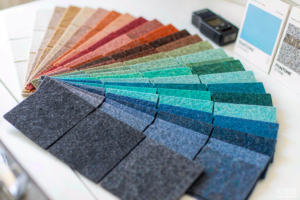
Flakes are melted and extruded into polyester fiber. At this stage, masterbatch pigments are added to produce the color palette — and here quality separates: consistent dye-lot control is what makes a panel installed this month match one installed last year. Manufacturers with in-house fiber production control this variable directly; those buying fiber on the open market do not.
Step 3: Thermo-bonding into felt
Fibers are carded into webs, layered to the target thickness, and passed through ovens where heat bonds the fibers together — no chemical binder, no formaldehyde resin. The panels emerge as rigid, cuttable felt sheets in 9mm, 12mm and 24mm gauges, with density tuned for acoustic performance. This binder-free construction is why PET panels are formaldehyde-free and low-VOC by nature, not by treatment.
Step 4: Fabrication
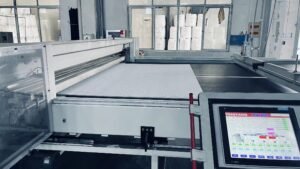
From base felt, the product range expands: plain wall panels, ceiling clouds and baffles, 3D-cut geometries, printed graphics, and — the fastest-growing application — the acoustic backing for wood slat panels, where real veneer slats mount onto PET felt to deliver both biophilic design and documented absorption.
Why the material won
- Performance: NRC up to 0.90 in 24mm, excellent speech-band absorption.
- Safety: no loose fibers, no skin irritation during fabrication, formaldehyde-free.
- Workability: cuts and CNCs cleanly on site with standard tools.
- Credentials: recycled content, recyclability and low emissions — points on every certification framework.
MST Acoustics’ vertical approach
MST Acoustics produces its PET panel families from recycled fiber with in-house control over thickness, density and color — the reason our batches match across years and continents. Hundreds of tons of bottles enter our production annually and leave as quiet, better-looking rooms. For buyers, the material is no longer an alternative: it is the standard against which everything else is measured.