Green building certification has become a standard requirement in commercial construction, and acoustics sits at the intersection of two of its pillars: occupant comfort and responsible materials. For suppliers and distributors, understanding exactly how acoustic panels earn points turns every project conversation into a specification opportunity.
The acoustic side: WELL leads, LEED follows
The WELL Building Standard treats acoustic comfort as a core concept. It sets measurable requirements for reverberation time in open and enclosed spaces, sound isolation between zones, and background noise levels. Panels with a documented absorption coefficient — tested in a reverberation room under ISO 354 or the equivalent ASTM C423 — give the acoustic consultant the data needed to model and certify the design.
LEED addresses acoustics most directly in schools and healthcare credits (reverberation time limits in classrooms, speech privacy in clinical areas), while the general interior-construction pathway rewards acoustic design through the integrative process and occupant comfort strategies.
The materials side: what panel attributes count
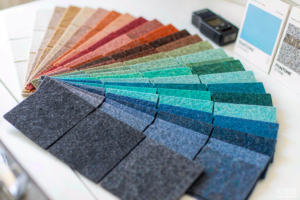
- Recycled content. Acoustic panels made from recycled PET bottles contribute to LEED’s sourcing and disclosure credits. A single 12mm panel line can represent tens of thousands of recycled bottles — a story both specifiers and their clients can use.
- Low-emitting materials. Formaldehyde and VOC emissions affect indoor air quality credits. Panels certified to E1 (or better, E0) formaldehyde class, with low-VOC adhesives and coatings, fit cleanly into the low-emitting materials calculations.
- Responsible sourcing. FSC-certified wood components in slat and perforated panels support responsible sourcing credits under both systems.
- Transparency documentation. Environmental Product Declarations (EPDs) and health product declarations are increasingly requested by consultants. Manufacturers who can issue these documents remove a real barrier from the specification.
What buyers should collect from suppliers
- ISO 354 / ASTM C423 absorption test report with NRC and per-octave-band coefficients.
- Formaldehyde class certificate (E1/E0) and low-VOC statement.
- Fire classification (EN 13501-1 or ASTM E84) for the exact product construction.
- FSC chain-of-custody certificate for wood-containing products.
- Recycled-content declaration with the percentage by weight.
MST Acoustics and certified projects
Our panels are engineered with certification projects in mind: recycled PET felt bodies, E1-class production, FSC-certified wood in slat panel lines, and full ISO 354 absorption reports available for every series. When your project targets LEED or WELL, send us the credit checklist early — we will map each panel attribute to the documentation your consultant needs, before the tender deadline rather than after.