Fire performance is where acoustic material conversations get confusing fastest. One project asks for B-s1,d0, the next for Class A, a third for “B1 grade” — all legitimate, all from different test systems, none interchangeable. This comparison map helps buyers translate between the fire languages their markets speak.
The four systems you will meet
- EN 13501-1 (Europe). The harmonized EU classification: fire contribution (A1–F), smoke (s1–s3), droplets (d0–d2). B-s1,d0 is the standard commercial requirement for wall and ceiling linings.
- ASTM E84 (North America). The tunnel test producing Flame Spread and Smoke Developed indices; Class A (FSI ≤ 25) is the default commercial spec.
- GB 8624 (China). Aligned in structure with EN 13501-1; B1 class (flammable but difficult to ignite) is the common requirement in Chinese public buildings.
- Legacy national classes. France M1, UK Class 0/1 and others still appear in tenders — each referencing the country’s historical test method, often satisfied today by an EN 13501-1 report plus translation.
How materials actually earn these ratings
Fire performance is a property of the whole construction — core, adhesive, coating and mounting. Practical patterns:
- Mineral and glass fiber cores are inherently non-combustible (A1/A2 territory) but bring handling and emission trade-offs.
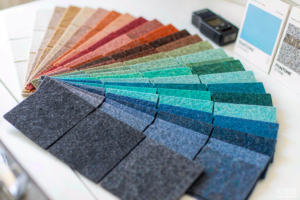
- PET felt is a polymer: untreated it contributes to fire, so professional panels rely on additives and construction to reach B-s1,d0 or Class A/B. Quality varies hugely between suppliers — always test the actual product, not the material category.
- Wood-faced panels combine combustible veneer with treated cores; fire-retardant treatments and tested assemblies carry the rating.
- Mounting matters. Panels fixed with air gaps behave differently from glued installations; reports state the tested mounting.
Buyer’s verification routine
For any fire-critical order: request the test report and the classification report (two separate documents in the EN system), check that the tested construction matches the shipment, note the laboratory’s accreditation, and keep copies in the project file. A fire claim without paperwork is a liability, not a feature.
MST Acoustics fire documentation
Our PET wall panels and wood slat systems are tested to EN 13501-1 B-s1,d0 and ASTM E84, with reports issued for the exact panel constructions we ship. Buyers serving multiple markets can request the full document set per product family — so the same panel that clears a European submittal can be quoted into a North American project without surprises.