Ask a factory for an acoustic panel quotation and the specification sheet will list a small but decisive line: formaldehyde class, E1 or E0. For importers of wood-based panels — MDF slat panels, perforated wood, grooved panels — this single property determines whether the product clears customs inspections, passes retail audits and satisfies indoor-air requirements. Here is what the classes mean in practice.
Where the formaldehyde comes from
Wood panels such as MDF and particleboard are bonded with urea-formaldehyde resins. Over time, finished boards emit small amounts of formaldehyde gas into indoor air. Because formaldehyde is classified as a carcinogen at certain exposure levels, markets regulate emission limits — and enforcement is tightening every year.
The classes and their limits
| Class | Standard | Limit (board) |
|---|---|---|
| E1 | EN 13986 / GB 18580 | ≤ 0.124 mg/m³ (chamber) / ≤ 0.124 mg/m²·h |
| E0 | stricter voluntary class | ≤ 0.050 mg/m³ (chamber) |
| CARB P2 / TSCA Title VI | US & California | ≤ 0.11 ppm for MDF (as applicable) |
E1 is the legal baseline for wood products sold in the EU and China; E0 is the stricter voluntary class that premium projects and children’s facilities increasingly demand. In North America, CARB Phase 2 and the federal TSCA Title VI rule play the equivalent role.
What importers must collect
- Test report from an accredited laboratory, on the specific board type and thickness used in your panels.
- Statement of origin identifying the board mill — formaldehyde class is a property of the raw board, so the chain starts there.
- Chamber test data for finished panels where your market requires it, not just the raw board certificate.
- Contractual warranty that production will continue to use boards of the declared class — dye-lot discipline applies to boards as much as to colors.
Why it matters commercially
Beyond compliance, emission class has become a sales argument. Schools, kindergartens, healthcare projects and residential fit-outs are the segments most sensitive to indoor air quality, and “E0 formaldehyde class” is a line that wins those tenders. Distributors who can document E1 as standard — and offer E0 as an upgrade — cover the entire market without carrying two inventories.
MST Acoustics emission control
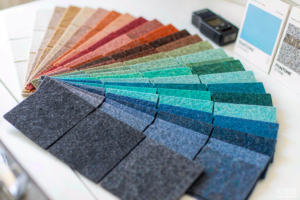
All wood-based MST Acoustics products — slat panels, grooved and perforated series — are produced on E1-class boards as standard, with E0 available for sensitive projects. PET felt panels are formaldehyde-free by material nature, which makes them the simplest compliance story for pure acoustic applications. The relevant test reports ship with every project document package on request.