
An airport terminal at peak hour is one of the most acoustically violent rooms humans regularly occupy: hard reflective floors stretching hundreds of meters, glass curtain walls, announcements competing with rolling luggage and jet engine bleed. Yet modern terminals are expected to deliver calm wayfinding and crystal-clear PA intelligibility. That contradiction has turned airports, rail stations and multimodal hubs into one of the fastest-growing and most demanding segments for acoustic panel suppliers.
Why transport acoustics are different
Three characteristics set transport projects apart from offices or schools. First, scale: a single terminal roof can swallow more panel square meters than an entire office tower, and every surface is treated to a budget in the millions. Second, PA intelligibility is a safety function: emergency announcements must be understood across vast hard spaces, which building codes and aviation authorities treat as non-negotiable — the absorption is engineered to serve the voice-alarm design. Third, the environment is public and permanent: surfaces must survive decades of cleaning regimes, impact from trolleys, and zero-tolerance fire rules.

What gets specified — and why
The workhorse of transport acoustics is the ceiling. Exposed structural soffits are acoustically dead weight, so designers deploy absorption where it does not touch the public:
- Perforated metal and wood ceilings with acoustic fleece backing — durable, cleanable, and able to span large modules. Perforated wood brings warmth to passenger halls while meeting stringent fire classes.
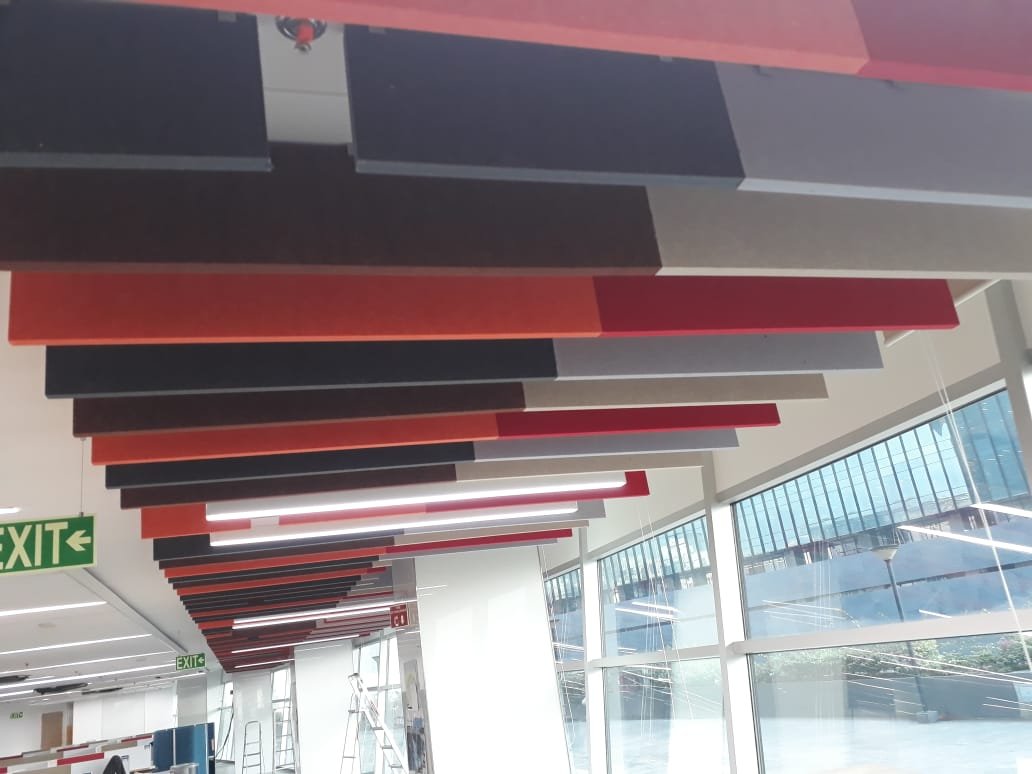
- Suspended baffles and clouds over concourses and check-in zones, positioned to target the speech-band frequencies of PA intelligibility.
- Impact-tolerant wall absorption in waiting areas and bus terminals — PET felt panels perform well here because they are impact-resistant, formaldehyde-free and available in fire-rated constructions.
Every product enters the building through a compliance gate: EN 13501-1 class (typically B-s1,d0 or A2), smoke-production limits, cleanability protocols, and long-cycle durability testing. The document pack is heavier than in any commercial segment — and so is the reward for suppliers who carry it.
How suppliers qualify for infrastructure work
Transport projects are tendered through consultant-led frameworks, and qualification follows a predictable path:
- Documents before relationships. Fire and absorption certificates are screened before anyone discusses price or design; a supplier without a current EN 13501-1 pack does not reach the shortlist.
- Project references at scale. Consultants look for prior installations in large public buildings — references that distributors can build up progressively through schools, hospitals and arenas before stepping into aviation.
- Program stamina. Terminal construction runs for years in phases. Suppliers must prove batch consistency across multi-year deliveries and hold production slots against a national schedule.
- Local compliance support. Customs classification, on-site technical representation and mock-up rooms are standard asks; the supplier who funds a terminal mock-up bay buys credibility that no brochure can buy.
The opportunity map
The segment is expanding on three fronts: mature markets retrofitting aging terminals, Gulf and Asian mega-hub construction, and the quiet revolution in secondary infrastructure — regional airports, metro extensions and bus rapid transit systems that adopt the same acoustic logic at friendlier price points. For panel manufacturers and distributors, the entry ticket is compliance discipline; the prize is the most specification-loyal customer base in the industry, because no consultant switches a qualified airport supplier lightly.
Transport acoustics will reward the patient. Build the document pack, collect the public-building references, and the airport segment stops being intimidating — it becomes the natural next rung on the ladder.
The Specification Reality: Durability Meets Acoustics
Transport projects impose a combination rarely found in commercial work: very high ceilings that need large-format or suspended elements, daily cleaning regimes, impact exposure from trolleys and luggage, and fire requirements at the strict end of the scale. The products that win these tenders reflect that mix – 24 mm and thicker PET felt panels for impact resistance, wood slat systems on rigid backing for large wall planes, and ceiling baffles suspended on engineered cables with locked height adjustment. Maintenance access is part of the specification too: any element above public reach must be cleanable in place or demountable, which pushes consultants toward systems with documented removal sequences rather than bonded installations.
Acoustic targets in hubs are typically expressed as reverberation limits in concourses and gate areas, and the absorption volumes involved are enormous – a single terminal hall can consume thousands of square metres of treatment. That scale changes the commercial dynamics: clients demand long-term supply security, batch-to-batch colour consistency, and the ability to produce replacement panels years later. Manufacturers with documented colour-batch control and an archival sample system hold a decisive advantage, because a hub expansion phase five years after the original build must match the existing interior exactly.
How Smaller Suppliers Can Enter the Segment
The full terminal hall is not the only entry point. Smaller packages – staff areas, airline lounges, ground transport interchanges, bus stations, and regional rail platforms – carry the same specification logic at volumes that mid-size manufacturers can serve credibly. Partnering with fit-out contractors who already hold framework agreements with transport authorities is the practical route in: bring certified products, installation documentation, and reference projects from other demanding segments such as hospitals or schools. Transport clients value suppliers who treat documentation as seriously as product performance, because every element in a public building must survive audit long after installation. Distributors who build that reputation in small transport packages position themselves for the major terminal programmes as the current investment cycle delivers them to market.
Key Takeaways
- Transport specs demand thick, impact-resistant panels, documented cleaning, and demountable fixings.
- Batch-to-batch colour consistency across years is the decisive manufacturing advantage.
- Enter through small packages – lounges, interchanges, regional stations – with fit-out partners already holding frameworks.
- Documentation discipline matters as much as product performance in public buildings.
Timing also favours new entrants right now. The current investment cycle in transport infrastructure runs through the middle of the next decade in most regions, and the interior packages – the packages that consume acoustic panels – are let later than structural packages, which means specification decisions are being made over the next two to three years. Suppliers who establish reference projects and documentation libraries now will find themselves on consultant lists when the major interior tenders open. That is the practical meaning of segment entry: not a single enormous order, but a position on the list when the enormous orders are written. Distributors who understand that rhythm treat small transport packages as strategic investments rather than modest sales, and price their effort accordingly.